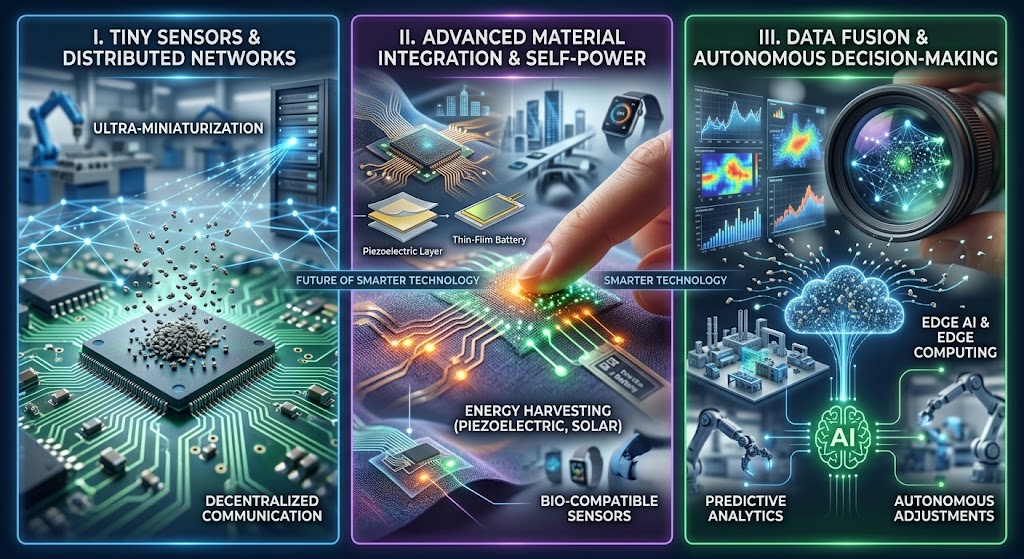
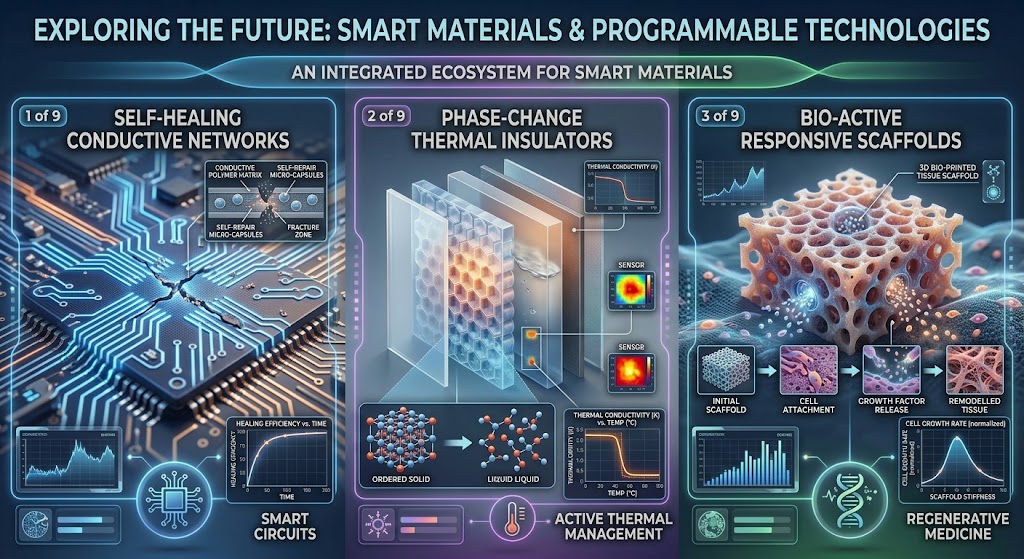
Smart Dust Technologies are emerging as an exciting area of technology that combines extremely small sensors, wireless communication, computing, and sensing capabilities into tiny devices. These miniature systems are designed to collect information about their surroundings and transmit useful data without requiring traditional large-scale hardware.
As sensor technology becomes smaller and more energy-efficient, Smart Dust Technologies could find applications in industrial monitoring, agriculture, environmental sensing, healthcare research, infrastructure, and other specialized fields.
Unlike ordinary sensors that are usually visible and relatively large, smart-dust concepts focus on creating sensing devices that can become almost invisible or operate in places where conventional equipment is difficult to install. This makes the field particularly interesting for researchers working on low-power electronics, microelectromechanical systems, wireless networks, and next-generation computing.
Table of Contents
- What Are Smart Dust Technologies?
- Why Smart Dust Technologies Matter
- 9 Powerful Smart Dust Technologies
- Smart Dust Technologies for Environmental Monitoring
- Smart Dust Technologies for Agriculture
- Smart Dust Technologies for Industrial Monitoring
- Challenges of Smart Dust Technologies
- Future of Smart Dust Technologies
- Conclusion
What Are Smart Dust Technologies?
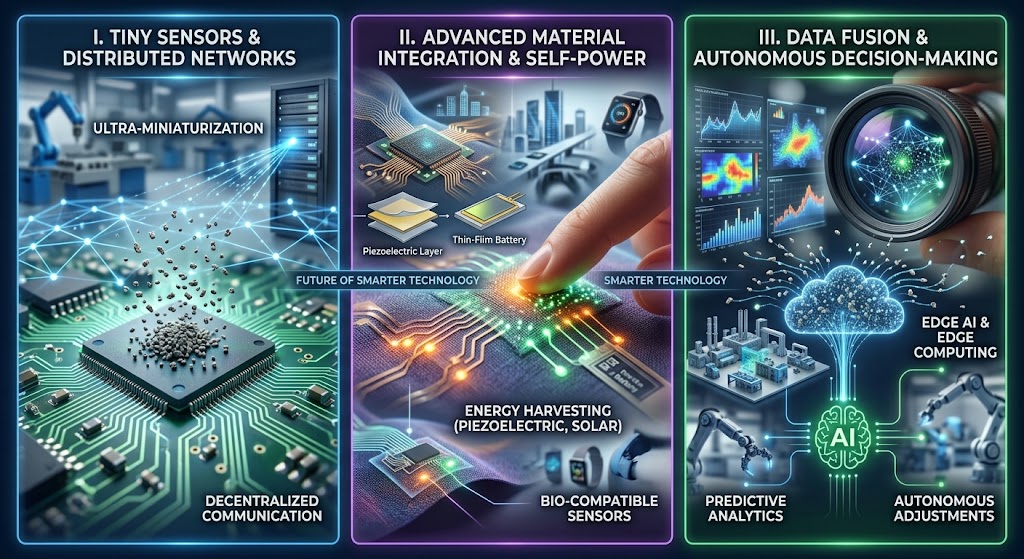
Smart Dust Technologies refer to miniature sensing and computing systems designed to detect information from the physical environment and communicate that information wirelessly. The idea is closely associated with tiny autonomous devices sometimes called “motes.” A mote can potentially contain sensors, processing components, communication hardware, and a power source or energy-harvesting mechanism.
The important concept behind Smart Dust Technologies is not simply making a sensor smaller. The goal is to create a complete sensing platform that can perform useful tasks despite having extremely limited space, energy, and computing resources.
Modern advances in microelectronics are making this concept more practical. Smaller processors, improved wireless communication, micro-scale sensors, and low-power electronics can work together to create sensing systems for highly specialized environments.
Why Smart Dust Technologies Matter
The potential of Smart Dust Technologies comes from their ability to gather information from locations where conventional sensors may be expensive, difficult, or impractical to deploy. Instead of installing a large monitoring system at every location, networks of tiny sensors could potentially provide distributed information.
This approach could be useful for monitoring temperature, pressure, humidity, vibration, chemical conditions, motion, or other environmental variables. In industrial environments, for example, miniature sensors could help researchers explore new approaches to equipment monitoring.
The technology is still developing, and many proposed applications remain research-focused rather than everyday commercial products. However, the underlying technologies are advancing across several areas of engineering.
9 Powerful Smart Dust Technologies
1. Smart Dust Technologies With MEMS Sensors
MEMS, or microelectromechanical systems, are among the most important building blocks behind Smart Dust Technologies. MEMS devices can combine tiny mechanical structures with electronic circuits, allowing sensors to detect physical changes in their surroundings.
MEMS technology can be used for sensing movement, pressure, acceleration, vibration, and other physical conditions. Because these components can be manufactured at very small scales, they are especially relevant to miniature sensing systems.
The continuing development of MEMS sensors could make future smart-dust devices more capable while keeping their physical size extremely small.
2. Smart Dust Technologies With Ultra-Low-Power Computing
Power consumption becomes a major challenge when computing hardware has to operate inside a miniature device. Smart Dust Technologies therefore depend heavily on processors and controllers that can perform useful calculations while consuming very little energy.
Instead of continuously sending every piece of raw sensor information to another computer, a tiny device could potentially process some information locally. This approach, often associated with edge computing, could reduce communication requirements and improve the efficiency of miniature sensor networks.
3. Smart Dust Technologies With Wireless Communication
Communication is another essential component of Smart Dust Technologies. A sensor that collects information but cannot transmit it has limited usefulness in a distributed network.
Researchers are exploring different low-power wireless approaches for connecting small sensing devices. Depending on the application, communication could involve short-range or specialized wireless systems designed around low energy consumption.
The challenge is balancing communication distance, data rate, reliability, antenna size, and power requirements inside an extremely small package.
4. Smart Dust Technologies With Energy Harvesting
Power is one of the biggest obstacles for miniature autonomous sensors. Batteries add physical size and eventually need replacement, which can be difficult if thousands of tiny devices are distributed across an environment.
For this reason, Smart Dust Technologies may benefit from energy harvesting. A miniature system could potentially obtain small amounts of energy from environmental sources such as light, vibration, heat differences, or radio-frequency energy.
Energy harvesting does not automatically eliminate the need for batteries, but it could potentially extend operating time or support extremely low-power sensing applications.
5. Smart Dust Technologies With Environmental Sensors
Environmental monitoring is one of the most interesting areas for Smart Dust Technologies. Tiny sensors could potentially monitor variables such as temperature, humidity, air conditions, light, or other environmental characteristics.
Instead of depending on a few large monitoring stations, researchers could investigate distributed sensing networks containing many small devices. This could provide more localized information and help create detailed environmental datasets.
However, practical deployment would depend on sensor accuracy, durability, communication reliability, maintenance requirements, and environmental conditions.
6. Smart Dust Technologies for Agriculture
Agriculture could also become an important research area for Smart Dust Technologies. Modern farming increasingly relies on sensors to understand soil and crop conditions, but installing and maintaining conventional sensors across large fields can require significant infrastructure.
Tiny sensing systems could potentially help researchers investigate more distributed approaches to monitoring moisture, temperature, soil conditions, and micro-environmental changes.
The biggest opportunity would be creating inexpensive and energy-efficient sensors that can operate for long periods without frequent maintenance.
7. Smart Dust Technologies for Industrial Monitoring
Industrial equipment produces large amounts of physical information through vibration, temperature, pressure, and other signals. Smart Dust Technologies could potentially provide new ways to monitor difficult-to-reach areas of machines and infrastructure.
For example, miniature sensors could be researched for detecting changes around mechanical systems where installing conventional monitoring equipment is complicated.
The concept could eventually complement existing industrial Internet of Things systems by adding extremely small sensing nodes to environments where ordinary sensors are less convenient.
8. Smart Dust Technologies With Tiny Chemical Sensors
Chemical sensing is another promising research direction. Tiny sensors can potentially be designed to detect particular chemical conditions or changes in an environment.
For Smart Dust Technologies, miniaturized chemical sensing could open possibilities in environmental research, industrial safety monitoring, and laboratory applications. However, chemical sensors can be more complicated than simple temperature or motion sensors because selectivity, calibration, contamination, and long-term stability can become important issues.
This means that practical chemical smart-dust systems require advances not only in electronics but also in materials science and sensor engineering.
9. Smart Dust Technologies With Self-Powered Sensors
The combination of ultra-low-power electronics and energy harvesting could lead to another important direction in Smart Dust Technologies: self-powered sensing.
A self-powered sensor would attempt to use energy available in its environment instead of relying entirely on a conventional battery. For example, a system operating near a vibrating machine might investigate vibration-based energy harvesting, while an outdoor sensor could potentially use available light.
The major challenge is that harvested energy can be unpredictable. Future systems will need extremely efficient hardware and intelligent power management to operate reliably.
Smart Dust Technologies for Environmental Monitoring
Smart Dust Technologies could eventually provide a new approach to environmental observation by distributing many small sensing devices across an area. A network could potentially collect localized measurements instead of depending only on a few fixed monitoring stations.
This concept could be particularly interesting for research environments where conditions change rapidly across small distances. However, environmental deployment also introduces challenges such as weather resistance, sensor degradation, communication range, and retrieval of devices after use.
Smart Dust Technologies for Agriculture
Agricultural applications could combine miniature sensors with data analytics and automated decision-making. Smart Dust Technologies could potentially help researchers study differences in soil moisture, temperature, and local growing conditions across individual areas of a field.
The value would come from gathering highly localized information rather than simply increasing the number of conventional sensors. Before large-scale adoption becomes realistic, researchers still need to address cost, durability, power supply, environmental impact, and deployment methods.
Smart Dust Technologies for Industrial Monitoring
Industrial environments are another potential application for Smart Dust Technologies because machines and infrastructure often contain difficult-to-access areas. Tiny sensors could potentially be placed in locations where traditional equipment would be inconvenient.
The collected information could be analyzed to identify unusual vibration, temperature changes, or other measurable conditions. Such systems could eventually complement existing predictive-maintenance technologies rather than completely replace them.
Smart Dust Technologies Comparison Table
| Technology | Main Purpose | Key Advantage | Major Challenge |
|---|---|---|---|
| MEMS Sensors | Physical sensing | Extremely small size | Manufacturing complexity |
| Ultra-Low-Power Computing | Local processing | Lower energy use | Limited computing resources |
| Wireless Communication | Data transmission | Distributed monitoring | Range and power limits |
| Energy Harvesting | Power generation | Reduced battery dependence | Variable energy supply |
| Environmental Sensors | Environmental data | Localized measurements | Sensor durability |
| Agricultural Sensors | Field monitoring | Detailed field information | Large-area deployment |
| Industrial Sensors | Equipment monitoring | Access to difficult areas | Reliability |
| Chemical Sensors | Chemical detection | Specialized sensing | Calibration and selectivity |
| Self-Powered Sensors | Long-term operation | Potentially longer lifespan | Limited available energy |
Smart Dust Technologies and Their Potential
The potential of Smart Dust Technologies can be understood through the combination of several engineering advances rather than through one single invention. Smaller sensors provide physical sensing, low-power processors provide basic computation, wireless systems provide communication, and energy harvesting may help address power limitations.
Smart Dust technology building blocks
Illustrative comparison of how different technology areas contribute to miniature sensing systems. Values are conceptual, not measured market data.0%25%50%75%100%
MEMS sensing
Low-power computing
Wireless communication
Energy harvesting
Environmental sensing
This chart is illustrative rather than a scientific ranking. It simply shows the major technology building blocks that commonly matter when designing miniature sensing systems.
Challenges of Smart Dust Technologies
Despite their potential, Smart Dust Technologies face substantial technical challenges. Size reduction creates trade-offs between computing power, communication capability, battery capacity, sensing accuracy, and durability.
Power remains one of the biggest problems. A device may be physically tiny, but it still needs enough energy to sense, process information, and communicate. Reducing energy consumption can therefore be just as important as reducing physical size.
Communication presents another difficulty. Tiny antennas and limited energy can make reliable long-distance communication challenging. A network may need carefully designed communication protocols to prevent small devices from wasting energy.
Privacy and security also deserve attention. If miniature sensors become widely deployed, protecting the information they collect and preventing unauthorized access would become increasingly important.
Future of Smart Dust Technologies
The future of Smart Dust Technologies will likely depend on progress across multiple fields rather than one breakthrough. Advances in semiconductor manufacturing, sensor materials, wireless communication, energy harvesting, and artificial intelligence could gradually improve the capabilities of miniature sensing platforms.
Future devices may become smaller while gaining better sensing and processing capabilities. More efficient electronics could allow tiny systems to remain operational for longer periods, while intelligent algorithms could help them decide which information is actually worth transmitting.
At the same time, responsible development will be important. Designers will need to consider privacy, security, environmental impact, device retrieval, and safe deployment alongside technical performance.
Conclusion
Smart Dust Technologies represent an intriguing direction in miniature sensing, combining tiny sensors, low-power computing, wireless communication, and innovative energy solutions. From environmental monitoring and agriculture to industrial research, these technologies could enable sensing approaches that are difficult to achieve with conventional hardware.
The technology is still evolving, and many ambitious smart-dust concepts remain in research and development rather than mainstream consumer use. Even so, advances in MEMS, low-power electronics, wireless networks, and energy harvesting are making miniature sensing increasingly capable. As these technologies mature, Smart Dust Technologies could become an important part of the broader movement toward smaller, more distributed, and more intelligent connected systems.