Blog

  • 9 Powerful Smart Dust Technologies Shaping the Future of Smarter Technology

    9 Powerful Smart Dust Technologies Shaping the Future of Smarter Technology

    Smart Dust Technologies are emerging as an exciting area of technology that combines extremely small sensors, wireless communication, computing, and sensing capabilities into tiny devices. These miniature systems are designed to collect information about their surroundings and transmit useful data without requiring traditional large-scale hardware.

    As sensor technology becomes smaller and more energy-efficient, Smart Dust Technologies could find applications in industrial monitoring, agriculture, environmental sensing, healthcare research, infrastructure, and other specialized fields.

    Unlike ordinary sensors that are usually visible and relatively large, smart-dust concepts focus on creating sensing devices that can become almost invisible or operate in places where conventional equipment is difficult to install. This makes the field particularly interesting for researchers working on low-power electronics, microelectromechanical systems, wireless networks, and next-generation computing.

    Table of Contents

    1. What Are Smart Dust Technologies?
    2. Why Smart Dust Technologies Matter
    3. 9 Powerful Smart Dust Technologies
    4. Smart Dust Technologies for Environmental Monitoring
    5. Smart Dust Technologies for Agriculture
    6. Smart Dust Technologies for Industrial Monitoring
    7. Challenges of Smart Dust Technologies
    8. Future of Smart Dust Technologies
    9. Conclusion

    What Are Smart Dust Technologies?
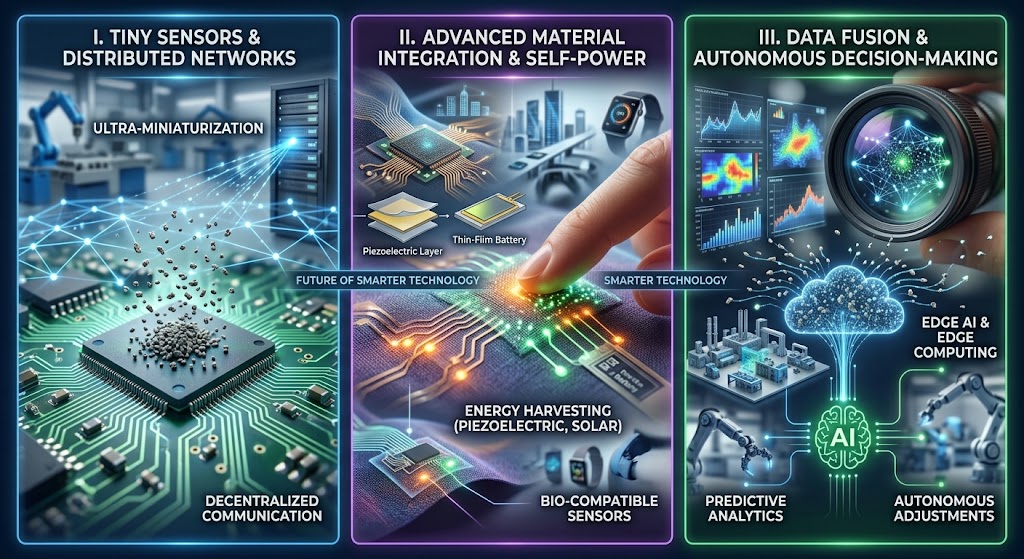
    Smart Dust Technologies refer to miniature sensing and computing systems designed to detect information from the physical environment and communicate that information wirelessly. The idea is closely associated with tiny autonomous devices sometimes called “motes.” A mote can potentially contain sensors, processing components, communication hardware, and a power source or energy-harvesting mechanism.

    The important concept behind Smart Dust Technologies is not simply making a sensor smaller. The goal is to create a complete sensing platform that can perform useful tasks despite having extremely limited space, energy, and computing resources.

    Modern advances in microelectronics are making this concept more practical. Smaller processors, improved wireless communication, micro-scale sensors, and low-power electronics can work together to create sensing systems for highly specialized environments.

    Why Smart Dust Technologies Matter

    The potential of Smart Dust Technologies comes from their ability to gather information from locations where conventional sensors may be expensive, difficult, or impractical to deploy. Instead of installing a large monitoring system at every location, networks of tiny sensors could potentially provide distributed information.

    This approach could be useful for monitoring temperature, pressure, humidity, vibration, chemical conditions, motion, or other environmental variables. In industrial environments, for example, miniature sensors could help researchers explore new approaches to equipment monitoring.

    The technology is still developing, and many proposed applications remain research-focused rather than everyday commercial products. However, the underlying technologies are advancing across several areas of engineering.

    9 Powerful Smart Dust Technologies

    1. Smart Dust Technologies With MEMS Sensors

    MEMS, or microelectromechanical systems, are among the most important building blocks behind Smart Dust Technologies. MEMS devices can combine tiny mechanical structures with electronic circuits, allowing sensors to detect physical changes in their surroundings.

    MEMS technology can be used for sensing movement, pressure, acceleration, vibration, and other physical conditions. Because these components can be manufactured at very small scales, they are especially relevant to miniature sensing systems.

    The continuing development of MEMS sensors could make future smart-dust devices more capable while keeping their physical size extremely small.

    2. Smart Dust Technologies With Ultra-Low-Power Computing

    Power consumption becomes a major challenge when computing hardware has to operate inside a miniature device. Smart Dust Technologies therefore depend heavily on processors and controllers that can perform useful calculations while consuming very little energy.

    Instead of continuously sending every piece of raw sensor information to another computer, a tiny device could potentially process some information locally. This approach, often associated with edge computing, could reduce communication requirements and improve the efficiency of miniature sensor networks.

    3. Smart Dust Technologies With Wireless Communication

    Communication is another essential component of Smart Dust Technologies. A sensor that collects information but cannot transmit it has limited usefulness in a distributed network.

    Researchers are exploring different low-power wireless approaches for connecting small sensing devices. Depending on the application, communication could involve short-range or specialized wireless systems designed around low energy consumption.

    The challenge is balancing communication distance, data rate, reliability, antenna size, and power requirements inside an extremely small package.

    4. Smart Dust Technologies With Energy Harvesting

    Power is one of the biggest obstacles for miniature autonomous sensors. Batteries add physical size and eventually need replacement, which can be difficult if thousands of tiny devices are distributed across an environment.

    For this reason, Smart Dust Technologies may benefit from energy harvesting. A miniature system could potentially obtain small amounts of energy from environmental sources such as light, vibration, heat differences, or radio-frequency energy.

    Energy harvesting does not automatically eliminate the need for batteries, but it could potentially extend operating time or support extremely low-power sensing applications.

    5. Smart Dust Technologies With Environmental Sensors

    Environmental monitoring is one of the most interesting areas for Smart Dust Technologies. Tiny sensors could potentially monitor variables such as temperature, humidity, air conditions, light, or other environmental characteristics.

    Instead of depending on a few large monitoring stations, researchers could investigate distributed sensing networks containing many small devices. This could provide more localized information and help create detailed environmental datasets.

    However, practical deployment would depend on sensor accuracy, durability, communication reliability, maintenance requirements, and environmental conditions.

    6. Smart Dust Technologies for Agriculture

    Agriculture could also become an important research area for Smart Dust Technologies. Modern farming increasingly relies on sensors to understand soil and crop conditions, but installing and maintaining conventional sensors across large fields can require significant infrastructure.

    Tiny sensing systems could potentially help researchers investigate more distributed approaches to monitoring moisture, temperature, soil conditions, and micro-environmental changes.

    The biggest opportunity would be creating inexpensive and energy-efficient sensors that can operate for long periods without frequent maintenance.

    7. Smart Dust Technologies for Industrial Monitoring

    Industrial equipment produces large amounts of physical information through vibration, temperature, pressure, and other signals. Smart Dust Technologies could potentially provide new ways to monitor difficult-to-reach areas of machines and infrastructure.

    For example, miniature sensors could be researched for detecting changes around mechanical systems where installing conventional monitoring equipment is complicated.

    The concept could eventually complement existing industrial Internet of Things systems by adding extremely small sensing nodes to environments where ordinary sensors are less convenient.

    8. Smart Dust Technologies With Tiny Chemical Sensors

    Chemical sensing is another promising research direction. Tiny sensors can potentially be designed to detect particular chemical conditions or changes in an environment.

    For Smart Dust Technologies, miniaturized chemical sensing could open possibilities in environmental research, industrial safety monitoring, and laboratory applications. However, chemical sensors can be more complicated than simple temperature or motion sensors because selectivity, calibration, contamination, and long-term stability can become important issues.

    This means that practical chemical smart-dust systems require advances not only in electronics but also in materials science and sensor engineering.

    9. Smart Dust Technologies With Self-Powered Sensors

    The combination of ultra-low-power electronics and energy harvesting could lead to another important direction in Smart Dust Technologies: self-powered sensing.

    A self-powered sensor would attempt to use energy available in its environment instead of relying entirely on a conventional battery. For example, a system operating near a vibrating machine might investigate vibration-based energy harvesting, while an outdoor sensor could potentially use available light.

    The major challenge is that harvested energy can be unpredictable. Future systems will need extremely efficient hardware and intelligent power management to operate reliably.

    Smart Dust Technologies for Environmental Monitoring

    Smart Dust Technologies could eventually provide a new approach to environmental observation by distributing many small sensing devices across an area. A network could potentially collect localized measurements instead of depending only on a few fixed monitoring stations.

    This concept could be particularly interesting for research environments where conditions change rapidly across small distances. However, environmental deployment also introduces challenges such as weather resistance, sensor degradation, communication range, and retrieval of devices after use.

    Smart Dust Technologies for Agriculture

    Agricultural applications could combine miniature sensors with data analytics and automated decision-making. Smart Dust Technologies could potentially help researchers study differences in soil moisture, temperature, and local growing conditions across individual areas of a field.

    The value would come from gathering highly localized information rather than simply increasing the number of conventional sensors. Before large-scale adoption becomes realistic, researchers still need to address cost, durability, power supply, environmental impact, and deployment methods.

    Smart Dust Technologies for Industrial Monitoring

    Industrial environments are another potential application for Smart Dust Technologies because machines and infrastructure often contain difficult-to-access areas. Tiny sensors could potentially be placed in locations where traditional equipment would be inconvenient.

    The collected information could be analyzed to identify unusual vibration, temperature changes, or other measurable conditions. Such systems could eventually complement existing predictive-maintenance technologies rather than completely replace them.

    Smart Dust Technologies Comparison Table

    TechnologyMain PurposeKey AdvantageMajor Challenge
    MEMS SensorsPhysical sensingExtremely small sizeManufacturing complexity
    Ultra-Low-Power ComputingLocal processingLower energy useLimited computing resources
    Wireless CommunicationData transmissionDistributed monitoringRange and power limits
    Energy HarvestingPower generationReduced battery dependenceVariable energy supply
    Environmental SensorsEnvironmental dataLocalized measurementsSensor durability
    Agricultural SensorsField monitoringDetailed field informationLarge-area deployment
    Industrial SensorsEquipment monitoringAccess to difficult areasReliability
    Chemical SensorsChemical detectionSpecialized sensingCalibration and selectivity
    Self-Powered SensorsLong-term operationPotentially longer lifespanLimited available energy

    Smart Dust Technologies and Their Potential

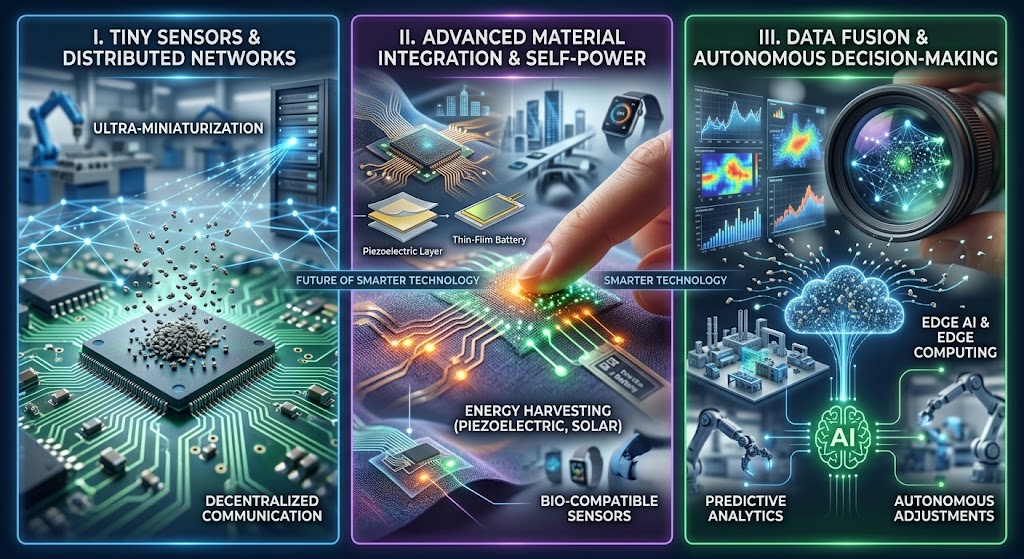
    The potential of Smart Dust Technologies can be understood through the combination of several engineering advances rather than through one single invention. Smaller sensors provide physical sensing, low-power processors provide basic computation, wireless systems provide communication, and energy harvesting may help address power limitations.

    Smart Dust technology building blocks

    Illustrative comparison of how different technology areas contribute to miniature sensing systems. Values are conceptual, not measured market data.0%25%50%75%100%

    MEMS sensing

    Low-power computing

    Wireless communication

    Energy harvesting

    Environmental sensing

    This chart is illustrative rather than a scientific ranking. It simply shows the major technology building blocks that commonly matter when designing miniature sensing systems.

    Challenges of Smart Dust Technologies

    Despite their potential, Smart Dust Technologies face substantial technical challenges. Size reduction creates trade-offs between computing power, communication capability, battery capacity, sensing accuracy, and durability.

    Power remains one of the biggest problems. A device may be physically tiny, but it still needs enough energy to sense, process information, and communicate. Reducing energy consumption can therefore be just as important as reducing physical size.

    Communication presents another difficulty. Tiny antennas and limited energy can make reliable long-distance communication challenging. A network may need carefully designed communication protocols to prevent small devices from wasting energy.

    Privacy and security also deserve attention. If miniature sensors become widely deployed, protecting the information they collect and preventing unauthorized access would become increasingly important.

    Future of Smart Dust Technologies

    The future of Smart Dust Technologies will likely depend on progress across multiple fields rather than one breakthrough. Advances in semiconductor manufacturing, sensor materials, wireless communication, energy harvesting, and artificial intelligence could gradually improve the capabilities of miniature sensing platforms.

    Future devices may become smaller while gaining better sensing and processing capabilities. More efficient electronics could allow tiny systems to remain operational for longer periods, while intelligent algorithms could help them decide which information is actually worth transmitting.

    At the same time, responsible development will be important. Designers will need to consider privacy, security, environmental impact, device retrieval, and safe deployment alongside technical performance.

    Conclusion

    Smart Dust Technologies represent an intriguing direction in miniature sensing, combining tiny sensors, low-power computing, wireless communication, and innovative energy solutions. From environmental monitoring and agriculture to industrial research, these technologies could enable sensing approaches that are difficult to achieve with conventional hardware.

    The technology is still evolving, and many ambitious smart-dust concepts remain in research and development rather than mainstream consumer use. Even so, advances in MEMS, low-power electronics, wireless networks, and energy harvesting are making miniature sensing increasingly capable. As these technologies mature, Smart Dust Technologies could become an important part of the broader movement toward smaller, more distributed, and more intelligent connected systems.
  • 9 Powerful Programmable Material Technologies for a Smarter Future

    9 Powerful Programmable Material Technologies for a Smarter Future

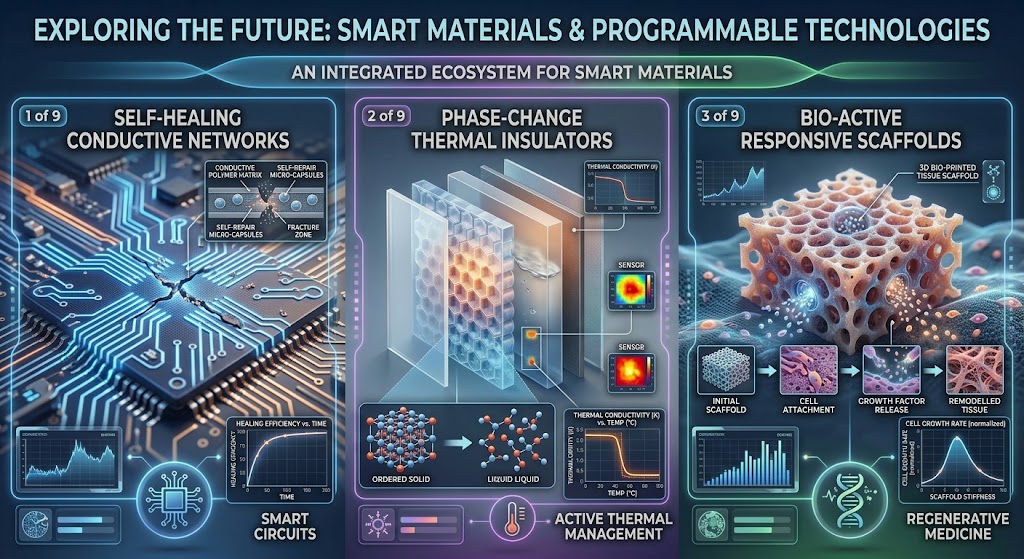
    Programmable Material Technologies are emerging technologies that allow materials to change, adapt, or perform specific functions based on programmed instructions, environmental conditions, or external signals. Instead of behaving like traditional fixed materials, these advanced materials can be designed to respond to temperature, light, electricity, pressure, magnetic fields, or other inputs. This makes Programmable Material Technologies an interesting area for future products, robotics, architecture, healthcare devices, manufacturing, and smart systems.

    The idea is broader than simply creating stronger or lighter materials. Researchers are exploring ways to give materials dynamic properties so that the material itself can participate in a technological process. As digital design, advanced manufacturing, smart materials, and microelectronics continue developing, Programmable Material Technologies could create products that are more adaptive, efficient, and responsive.

    Table of Contents

    1. What Are Programmable Material Technologies?
    2. Why Programmable Material Technologies Matter
    3. 9 Powerful Programmable Material Technologies
    4. Programmable Material Technologies in Robotics
    5. Programmable Material Technologies in Healthcare
    6. Programmable Material Technologies in Construction
    7. Challenges of Programmable Material Technologies
    8. Future of Programmable Material Technologies
    9. Conclusion

    What Are Programmable Material Technologies?

    Programmable Material Technologies describe approaches where the properties or behavior of a material can be deliberately controlled through design, embedded structures, chemistry, digital instructions, or external energy.

    A traditional material generally has relatively stable properties. A programmable material, by comparison, can be engineered to respond to changing conditions. For example, a material might change its shape when heated, alter its stiffness when exposed to an electrical signal, or transform its structure after receiving a particular stimulus.

    This field combines concepts from materials science, mechanical engineering, electronics, robotics, computer science, and advanced manufacturing. The result is a technology area where the boundary between software and physical materials becomes less clear.

    Why Programmable Material Technologies Matter

    The importance of Programmable Material Technologies comes from their potential to make physical objects more adaptive. Instead of designing one product for one fixed condition, engineers can explore materials that respond to different environments.

    This could eventually reduce the need for complex mechanical systems in some applications. A material capable of changing its own configuration may perform a function that would otherwise require motors, hinges, or additional components.

    Programmable materials could also support more personalized products. In healthcare, for example, responsive materials could potentially be designed for specific medical applications. In robotics, materials that change stiffness or shape could help machines become more flexible.

    9 Powerful Programmable Material Technologies

    1. Programmable Material Technologies With Shape-Memory Materials

    Shape-memory materials can be engineered to return toward a predetermined configuration after experiencing particular conditions. Temperature is one commonly studied trigger, although other mechanisms can also be used.

    This makes shape-memory materials particularly interesting for Programmable Material Technologies because the material can effectively store information about a desired shape.

    Potential applications include medical devices, actuators, aerospace components, and compact mechanical systems. Instead of using a conventional motor to create every movement, engineers can investigate whether the material itself can provide part of the required motion.

    2. Programmable Material Technologies With 4D Printing

    4D printing extends the concept of 3D printing by creating structures that can change over time in response to specific conditions. The additional dimension is not simply physical space; it represents transformation or behavior over time.

    With Programmable Material Technologies, 4D-printed structures can be designed so that their geometry changes after exposure to heat, moisture, light, or another stimulus.

    This approach could become useful for adaptive products, deployable structures, medical applications, and advanced robotics. The technology remains an active research area, but it demonstrates how manufacturing and programmable materials can work together.

    3. Programmable Material Technologies With Metamaterials

    Metamaterials are engineered structures whose unusual properties can come from their internal architecture rather than simply their chemical composition. By carefully designing microscopic or larger-scale patterns, researchers can produce physical responses that are difficult to achieve with conventional materials.

    In Programmable Material Technologies, metamaterial concepts could allow engineers to control how a material interacts with light, sound, electromagnetic waves, or mechanical forces.

    Potential applications include advanced antennas, sensing systems, acoustic devices, and optical technologies. Their future usefulness depends heavily on manufacturing accuracy and the ability to produce complex structures economically.

    4. Programmable Material Technologies With Electrically Responsive Materials

    Some smart materials respond to electrical stimulation by changing their shape, stiffness, or other physical properties. These materials are especially interesting for technologies that require controlled movement without relying entirely on traditional mechanical components.

    Programmable Material Technologies based on electrical responsiveness could support soft robotics, haptic interfaces, wearable devices, and adaptive mechanisms.

    The major advantage is that electrical signals can be precisely controlled through electronic systems. This creates a direct connection between software instructions and physical material behavior.

    5. Programmable Material Technologies With Light-Responsive Materials

    Light can also be used as a trigger for material transformation. Researchers are studying materials that respond to particular wavelengths or light intensities by changing their physical or chemical properties.

    This approach could make Programmable Material Technologies useful for systems where remote or highly localized control is important. Light can potentially activate a material without direct physical contact.

    Future applications could include optical devices, medical research, sensors, adaptive surfaces, and advanced manufacturing processes.

    6. Programmable Material Technologies With Self-Healing Materials

    Self-healing materials are designed to repair or restore some level of their function after experiencing damage. Depending on the material, healing can be triggered by heat, chemical reactions, light, moisture, or other mechanisms.

    Although self-healing does not always mean completely automatic repair, the concept is highly relevant to Programmable Material Technologies because material behavior can be deliberately engineered to respond to damage.

    Such materials could eventually have applications in coatings, electronics, infrastructure, automotive components, and other systems where maintenance is difficult or expensive.

    7. Programmable Material Technologies With Variable-Stiffness Materials

    A material that can change from relatively flexible to relatively rigid could provide valuable advantages for robotics and adaptive structures.

    Variable-stiffness materials are therefore an important area within Programmable Material Technologies. A robotic system could potentially use a flexible state for movement and a stiffer state for support or force transmission.

    This concept is especially relevant to soft robotics, where researchers want machines to combine flexibility with controlled strength.

    8. Programmable Material Technologies With Magnetic Materials

    Magnetic fields can provide another method of controlling material behavior. Certain engineered materials and structures can respond to magnetic forces, allowing their movement or configuration to be controlled without direct mechanical contact.

    For Programmable Material Technologies, magnetic control could support miniature robotics, medical devices, sensors, adaptive structures, and laboratory systems.

    One interesting feature of magnetic control is that the activating mechanism can sometimes remain outside the material itself, providing a way to manipulate small structures remotely.

    9. Programmable Material Technologies With Responsive Textiles

    Textiles are also becoming more technologically advanced. Researchers are developing materials and fabrics that can respond to temperature, moisture, electricity, pressure, or other conditions.

    These developments could expand Programmable Material Technologies into wearable technology. Future fabrics might be designed to change properties depending on environmental conditions or user requirements.

    Responsive textiles could have potential applications in sports equipment, healthcare monitoring, protective clothing, adaptive fashion, and human-machine interfaces.

    Programmable Material Technologies in Robotics

    Robotics is one of the areas where Programmable Material Technologies could have a particularly interesting impact. Conventional robots often depend on rigid mechanical structures, motors, gears, and joints. Programmable materials could allow some robotic functions to be integrated directly into the material.

    Soft robots are an example of this direction. Instead of relying exclusively on rigid components, soft robotic systems can use flexible materials that deform when activated.

    The long-term goal is not necessarily to eliminate conventional robotics hardware. Instead, programmable materials could complement electronics, sensors, actuators, and software to create machines capable of adapting to changing environments.

    Programmable Material Technologies in Healthcare

    Healthcare is another field where responsive materials could become useful. Medical devices sometimes need to interact with complex biological environments, making adaptability valuable.

    Programmable Material Technologies could potentially support drug-delivery systems, implants, surgical tools, tissue-engineering research, and wearable medical devices.

    However, healthcare applications require much higher standards for safety, reliability, biocompatibility, and regulatory validation. A material that works well in a laboratory demonstration may require extensive testing before it can be used in a medical product.

    Programmable Material Technologies in Construction

    Buildings and infrastructure are normally designed around relatively stable materials, but programmable materials could introduce more adaptive approaches.

    Future research could investigate materials that respond to temperature, pressure, sunlight, moisture, or structural conditions. Programmable Material Technologies could potentially support adaptive building components that change their properties according to environmental requirements.

    For example, researchers could explore responsive surfaces that regulate light or heat. Such concepts could eventually contribute to energy-efficient building designs, although practical implementation would depend on cost, durability, and large-scale manufacturing.

    Programmable Material Technologies Comparison Table

    TechnologyMain TriggerPotential ApplicationKey Advantage
    Shape-memory materialsHeat or stimulusActuators and medical devicesShape transformation
    4D printingHeat, moisture, lightAdaptive structuresTime-dependent transformation
    MetamaterialsPhysical interactionOptics and sensingEngineered unusual properties
    Electrically responsive materialsElectricityRobotics and wearablesElectronic control
    Light-responsive materialsLightSensors and adaptive systemsRemote activation
    Self-healing materialsDamage or stimulusCoatings and infrastructureReduced maintenance
    Variable-stiffness materialsHeat, electricity, pressureSoft roboticsFlexible-to-rigid behavior
    Magnetic materialsMagnetic fieldRobotics and medical researchContactless control
    Responsive textilesTemperature, moisture, electricityWearablesAdaptive clothing

    Programmable Material Technologies and Future Potential

    The development of Programmable Material Technologies depends on progress in several areas at the same time. Better materials are important, but advanced manufacturing is equally necessary because many programmable structures require precise internal designs.

    Computing also plays an important role. Digital simulations can help engineers predict how materials will behave before physical prototypes are produced. Artificial intelligence may further assist researchers in exploring large numbers of material structures and identifying promising designs.

    Key building blocks of programmable materials

    Illustrative conceptual view of major technology areas involved in programmable material development. Values are not market measurements or scientific rankings.0%25%50%75%100%

    Material science

    Advanced manufacturing

    Digital design

    Sensors and electronics

    Computational modeling

    The chart is illustrative, not a measured ranking. It highlights the different technology areas that can contribute to the development of programmable materials.

    Challenges of Programmable Material Technologies

    Despite their exciting potential, Programmable Material Technologies still face several challenges. One of the biggest is reliability. A material that changes shape or properties must perform consistently over repeated cycles.

    Manufacturing is another major challenge. Some programmable materials require highly precise structures that can be difficult or expensive to produce at large scale.

    Durability is equally important. Materials used in real-world products may experience heat, moisture, mechanical stress, chemicals, and repeated movement. A laboratory prototype may behave differently after months or years of real-world use.

    Cost can also slow adoption. New materials often require specialized manufacturing equipment and testing. Before they become mainstream, engineers need to demonstrate that their benefits justify the additional complexity.

    Future of Programmable Material Technologies

    The future of Programmable Material Technologies could become increasingly connected with artificial intelligence, robotics, digital manufacturing, and advanced sensors. Instead of simply manufacturing a material with fixed characteristics, engineers may increasingly design materials around specific behaviors.

    One possible direction is greater integration between software and physical materials. A digital system could provide instructions while the material performs the physical transformation. This could make future products more adaptive without requiring large numbers of mechanical components.

    Another important direction is sustainable manufacturing. If programmable materials can help products become lighter, longer-lasting, repairable, or more efficient, they could contribute to new approaches to product design. However, their environmental benefits will depend on how materials are produced, used, repaired, and eventually recycled.

    Conclusion

    Programmable Material Technologies are creating a fascinating connection between materials science and digital technology. Shape-memory materials, 4D printing, metamaterials, responsive textiles, self-healing materials, and variable-stiffness systems demonstrate how future materials could do more than simply provide structure.

    The technology is still developing, and many applications remain experimental or specialized. Yet the combination of advanced materials, digital design, smart manufacturing, sensors, and computing could make physical products increasingly adaptive.

    As research continues, Programmable Material Technologies could contribute to smarter robots, responsive buildings, advanced healthcare devices, adaptive wearables, and other technologies designed for a more flexible and intelligent future.