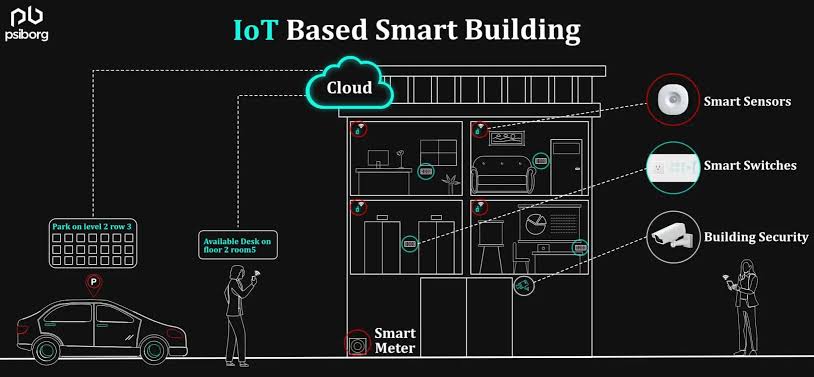
Building Sensor Technologies are changing ordinary buildings into intelligent environments that can understand what is happening inside them. Instead of relying only on fixed schedules and manual controls, modern buildings can use sensors to monitor occupancy, temperature, humidity, air quality, lighting, equipment performance, and even structural conditions. These technologies allow building systems to respond to real-world conditions rather than simply following predetermined settings.
Research from the U.S. Department of Energy highlights sensors and controls as an important part of improving building energy efficiency, occupant comfort, equipment monitoring, and fault detection. As sensor networks become smaller, cheaper, and more connected, the idea of a building acting like a giant sensing system is becoming increasingly practical.
Table of Contents
- Building Sensor Technologies for Occupancy Detection
- Building Sensor Technologies for Indoor Air Quality
- Building Sensor Technologies for Temperature and Humidity
- Building Sensor Technologies for Smart Lighting
- Building Sensor Technologies for Equipment Health
- Building Sensor Technologies for Structural Monitoring
- Building Sensor Technologies With AI and IoT
- Benefits and Challenges
- Future of Building Sensor Technologies
1. Building Sensor Technologies for Occupancy Detection
One of the most useful applications of Building Sensor Technologies is detecting where people are and how spaces are being used. Occupancy sensors can identify whether rooms are occupied and provide information that building management systems can use to adjust lighting, heating, ventilation, and air conditioning.
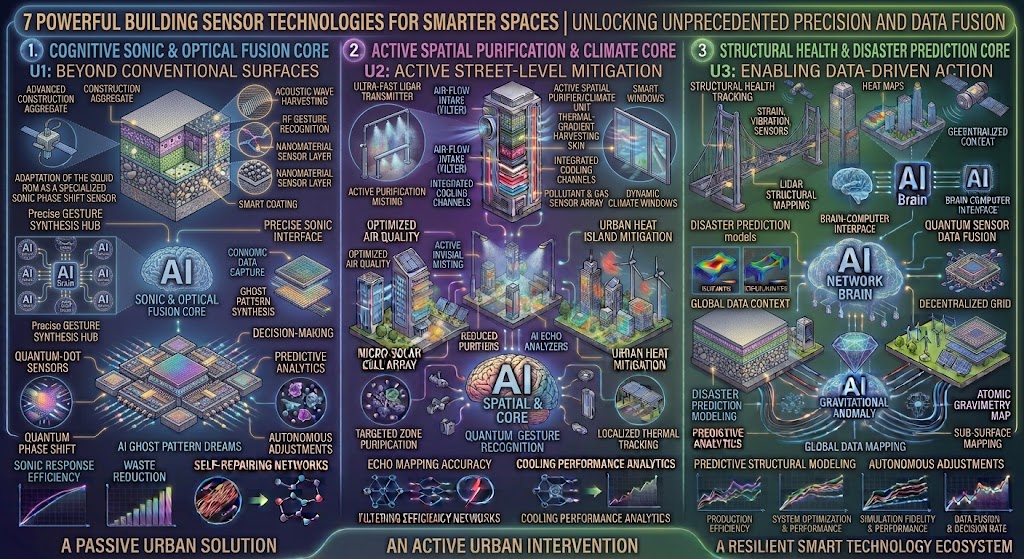
Traditional buildings often operate according to schedules. A meeting room might receive the same amount of heating or cooling whether five people are inside or nobody is there. Occupancy sensing allows the building to react more dynamically.
Passive infrared, ultrasonic, thermal imaging, and other sensing approaches can be used for occupancy detection. Research has also explored combining multiple non-intrusive sensor inputs, such as temperature and motion, to estimate occupancy.
Smarter Space Management
The information collected by these Building Sensor Technologies can help organizations understand which rooms are heavily used and which spaces remain empty for long periods. This can support better space planning while potentially reducing unnecessary energy use.
2. Building Sensor Technologies for Indoor Air Quality
Buildings can also become environmental monitoring platforms through sensors that measure indoor air conditions. Carbon dioxide, temperature, humidity, particulate matter, and other environmental measurements can provide useful information about indoor conditions.
Carbon dioxide sensing is particularly useful because CO₂ levels can provide an indication of ventilation conditions and occupancy patterns. When combined with other measurements, these sensors can help building systems respond to changing indoor environments.
Healthier Indoor Environments
Poor ventilation can affect comfort and indoor environmental quality. Building Sensor Technologies can continuously collect environmental information instead of relying on occasional manual measurements.
The U.S. Department of Energy has supported building-monitoring research involving humidity, occupancy estimation, thermal conditions, and indoor air quality.
This creates an important shift: instead of treating indoor air as something that is checked occasionally, a smart building can continuously monitor its environment.
3. Building Sensor Technologies for Temperature and Humidity
Temperature and humidity sensors are among the most established forms of Building Sensor Technologies, but their role is becoming more intelligent as they connect with automated building controls.
A network of sensors can measure conditions in different rooms, floors, or zones. Building management software can then compare these measurements with desired conditions and adjust heating, cooling, or ventilation systems.
Beyond a Single Thermostat
A traditional thermostat provides information about a relatively small area. Distributed sensing can provide a much more detailed picture of conditions throughout a building.
For example, one side of a large office may receive direct sunlight while another side remains shaded. Sensors positioned in different areas can detect these differences and provide data for more targeted control.
Research reviews identify temperature and humidity among the major sensing categories used for building environmental monitoring.
4. Building Sensor Technologies for Smart Lighting
Lighting systems are another area where Building Sensor Technologies can transform ordinary buildings.
Occupancy sensors can help determine whether people are using a space, while light sensors can measure the amount of available illumination. A smart lighting system can use this information to adjust artificial lighting according to actual conditions.
Adaptive Lighting
Imagine entering an office during daylight hours. Instead of turning on every light at full brightness, the building could determine that natural sunlight is already providing sufficient illumination in certain areas.
When combined with occupancy information, smart lighting can become even more adaptive. Empty areas may require less artificial lighting, while occupied spaces can maintain appropriate illumination.
The Department of Energy describes sensor-and-control research focused on integrating occupancy information, environmental conditions, and building controls to improve efficiency and occupant comfort.
5. Building Sensor Technologies for Equipment Health
Buildings contain many machines that require continuous operation, including HVAC systems, pumps, fans, elevators, chillers, and other mechanical equipment.
Modern Building Sensor Technologies can monitor equipment-related information such as temperature, vibration, pressure, airflow, and operating patterns. Data analytics can then help identify unusual behavior.
Predicting Problems Earlier
Instead of waiting until a machine completely fails, sensor data can sometimes reveal abnormal conditions before a major breakdown occurs.
This approach is closely related to fault detection and diagnostics. NIST describes intelligent building systems as capable of using sensor information to optimize system performance and detect faults or operational problems.
For building owners, this can create opportunities for more proactive maintenance. A developing equipment problem may be investigated before it causes a larger disruption.
6. Building Sensor Technologies for Structural Monitoring
Not every building sensor is focused on comfort or energy. Some Building Sensor Technologies can monitor the physical condition of structures.
Structural health monitoring can use sensors to observe parameters such as vibration, strain, displacement, or other changes associated with the condition of a building.
Turning Structures Into Data Sources
A building equipped with distributed structural sensors can provide information about how different parts of the structure behave over time.
Research into structural health monitoring shows how smart sensors, wireless networks, IoT technologies, cloud computing, and machine learning are being explored for monitoring structures and identifying potential damage.
This does not mean sensors can replace professional structural inspections. Instead, they can provide additional continuous information that engineers can use alongside established inspection methods.
7. Building Sensor Technologies With AI and IoT
The real transformation happens when Building Sensor Technologies are connected through IoT networks and analyzed with intelligent software.
A single sensor may only provide one measurement. Thousands of connected sensors can create a detailed digital picture of a building.
AI Turns Sensor Data Into Decisions
Artificial intelligence and machine-learning systems can analyze patterns across different sensor streams. For example, occupancy information could be combined with temperature, weather, energy consumption, and equipment data.
This could allow a building management system to recognize patterns and adjust operations more intelligently.
Research on smart-building sensing has examined how IoT devices and sensor data can be used to infer occupancy and occupant activities while supporting energy management, comfort, and space utilization.
The goal is not simply to collect more data. The goal is to turn that data into useful building decisions.
Building Sensor Technologies Comparison Table
| Technology | What It Detects | Main Application | Potential Benefit |
|---|---|---|---|
| Occupancy Sensors | Human presence | HVAC and lighting | Smarter space control |
| Air Quality Sensors | CO₂ and pollutants | Ventilation | Better indoor monitoring |
| Temperature Sensors | Heat levels | HVAC control | Improved comfort |
| Humidity Sensors | Moisture levels | Climate control | Environmental monitoring |
| Light Sensors | Illumination | Smart lighting | Adaptive lighting |
| Equipment Sensors | Machine conditions | Maintenance | Earlier fault detection |
| Structural Sensors | Vibration and strain | Building monitoring | Structural awareness |
How a Building Can Become a Giant Sensor
The concept becomes clearer when different sensing systems work together.
An occupancy sensor can detect people entering a room. Temperature sensors can measure the environment. Air-quality sensors can monitor ventilation conditions. Light sensors can measure natural illumination, while equipment sensors monitor HVAC performance.
All of this information can be connected through a building management platform.
The result is a building that continuously produces data about its own operation.
Illustrative Building Intelligence Flow
Sensors → Wireless/Wired Network → Data Platform → AI Analytics → Building Controls → Automated Response
This architecture can allow a building to move from simple automation toward adaptive operation.
Illustrative Technology Impact Graph
The following graph is illustrative, not a measured industry ranking. It represents the relative role different sensing categories can play in making a building more data-aware.
| Sensor Category | Illustrative Intelligence Contribution |
|---|---|
| Occupancy | 90 |
| Air Quality | 85 |
| Equipment Health | 88 |
| Temperature & Humidity | 82 |
| Lighting | 76 |
| Structural Monitoring | 72 |
| AI & IoT Integration | 95 |
The purpose of this illustration is to show how multiple sensing categories can contribute to an intelligent building ecosystem rather than suggesting verified performance percentages.
Benefits of Building Sensor Technologies
The biggest advantage of Building Sensor Technologies is continuous awareness. A building can gather information about its environment and systems without requiring people to manually check every condition.
Energy management is another major application. The Department of Energy describes research into sensors and controls aimed at optimizing building equipment while balancing energy efficiency and occupant comfort.
These technologies can also support maintenance, space utilization, indoor environmental monitoring, lighting control, and equipment diagnostics.
Another advantage is scalability. Sensors can be installed across individual rooms, entire floors, or large facilities. Wireless technologies can also reduce the need for extensive cabling in some applications.
Challenges of Building Sensor Technologies
Despite their potential, Building Sensor Technologies are not perfect.
Sensor accuracy is an important issue because poor-quality or badly positioned sensors can produce misleading information. Research has also identified challenges involving sensor placement, energy supply, networking, packaging, and performance validation.
Privacy can also become an important consideration when buildings collect occupancy or behavioral information. Systems should therefore be designed with appropriate data governance and security measures.
Another challenge is interoperability. Sensors from different manufacturers may use different communication technologies and data formats. Connecting them into one reliable system can require additional software and infrastructure.
Future of Building Sensor Technologies
The future of Building Sensor Technologies is likely to involve smaller sensors, better wireless connectivity, improved energy efficiency, and more advanced analytics.
Self-powered sensors are also being researched. The Department of Energy has highlighted work on low-cost wireless sensor networks designed to monitor multiple physical parameters while reducing maintenance requirements.
AI could further change how buildings respond to sensor information. Instead of simply reporting that a room is empty or that a machine is operating at an unusual temperature, future systems may combine multiple signals to identify patterns and recommend or automatically initiate appropriate responses.
Buildings could eventually behave less like static structures and more like continuously monitored digital systems.
Conclusion
Building Sensor Technologies are turning buildings into intelligent environments capable of sensing occupancy, air quality, temperature, lighting, equipment conditions, and structural behavior. When these technologies are connected through IoT platforms and analyzed with AI, they can provide a much richer understanding of how buildings operate.
The most important development is not any single sensor. It is the combination of many sensing technologies into one connected ecosystem. As sensors become more affordable, efficient, wireless, and intelligent, the concept of a building that can continuously understand its surroundings is becoming increasingly realistic.
For future smart buildings, the walls, rooms, machines, and environmental systems may no longer be passive parts of a structure. They can become active sources of information that help buildings operate more intelligently.