Programmable Surface Technologies are changing the way researchers think about walls, panels, interfaces, building materials, wireless systems, and everyday objects. Instead of treating a surface as something fixed and passive, programmable systems can be designed to change how they interact with light, radio waves, touch, air, force, shape, or information. Research from MIT has explored programmable surfaces made from arrays of small cells that can compute, communicate, and actuate, while newer work is investigating surfaces that can dynamically manipulate electromagnetic waves.
The idea is powerful because a programmable surface does not necessarily need to remain the same throughout its lifetime. Software, sensors, actuators, or responsive materials can allow its behavior to change according to a command or environmental condition. This opens possibilities for smarter buildings, adaptive interfaces, wireless communication, robotics, transportation, architecture, and future manufacturing.
Table of Contents
- What Are Programmable Surface Technologies?
- Shape-Changing Programmable Surface Technologies
- Reconfigurable Wireless Programmable Surface Technologies
- Touch-Sensitive Programmable Surface Technologies
- Light-Controlled Programmable Surface Technologies
- Texture-Changing Programmable Surface Technologies
- Airflow-Control Programmable Surface Technologies
- Adaptive Material Programmable Surface Technologies
- Interactive Display Programmable Surface Technologies
- Self-Transforming Programmable Surface Technologies
- Comparison Table
- Future of Programmable Surface Technologies
What Are Programmable Surface Technologies?
Programmable Surface Technologies describe surfaces whose physical behavior or function can be controlled, adjusted, or reconfigured through digital instructions, electronic systems, mechanical structures, or responsive materials.
A traditional wall, panel, screen, or tabletop normally has a fixed physical behavior. A programmable surface attempts to change that relationship. It might alter its shape, texture, optical appearance, permeability, stiffness, or interaction with electromagnetic waves.
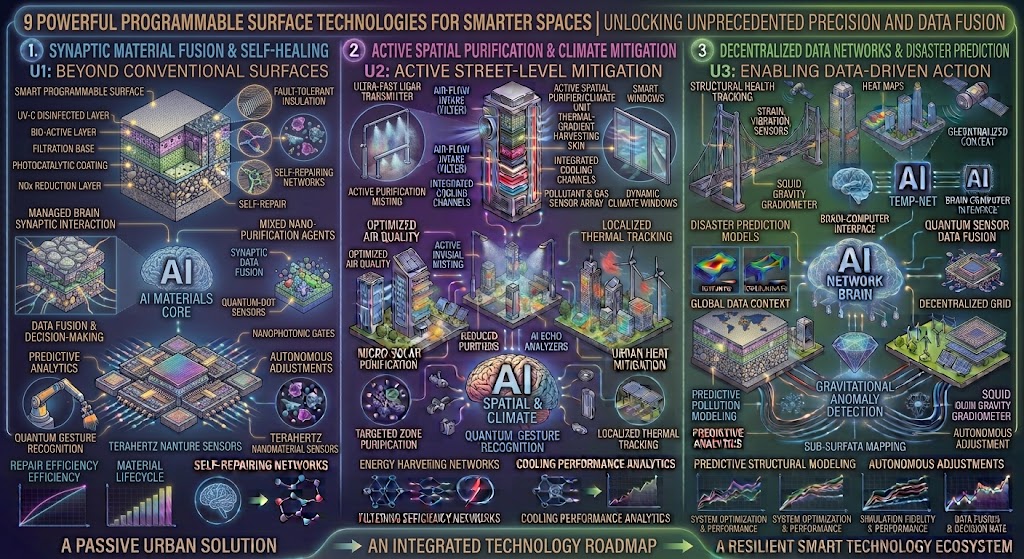
MIT research describes programmable matter as physical material capable of incorporating computation, sensing, actuation, and display functions, while its programmable-surface work explores arrays of individually controlled cells.
This means the surface itself can become part of the technology rather than simply providing a place where technology is attached.
1. Shape-Changing Programmable Surface Technologies
One of the most visually impressive forms of Programmable Surface Technologies involves surfaces that can physically change shape.
Instead of remaining flat, a surface can potentially bend, fold, expand, contract, or create different physical patterns when controlled by an external system.
How Shape-Changing Programmable Surface Technologies Work
Researchers have explored different combinations of actuators, flexible materials, pneumatic structures, mechanical elements, and programmable material properties to create surfaces capable of transformation.
MIT Media Lab research on shape-changing interfaces has explored surfaces that can modify their topology, texture, and permeability.
A future wall could therefore potentially change its geometry for ventilation, interaction, decoration, or functional control instead of remaining completely static.
2. Reconfigurable Wireless Programmable Surface Technologies
Another important category of Programmable Surface Technologies involves controlling electromagnetic waves.
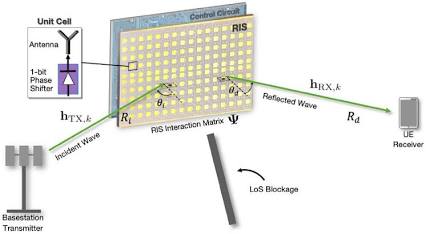
Reconfigurable intelligent surfaces, often called RIS, use arrays of controllable elements to influence how radio waves propagate through an environment. Instead of allowing walls and other surfaces to passively reflect signals, the surface can be electronically configured to alter their behavior.
Smart Wireless Environments
Research published in Nature Communications describes programmable metasurfaces capable of dynamically manipulating electromagnetic waves. More recent work has investigated surfaces that can both sense the wireless environment and manipulate electromagnetic waves in real time.
This could eventually make walls, ceilings, or building facades active components of wireless networks.
Rather than simply installing more transmitters, future environments could use programmable surfaces to help shape where wireless energy travels.
3. Touch-Sensitive Programmable Surface Technologies
Touch is another area where Programmable Surface Technologies could change everyday interfaces.
Current touchscreen devices already allow flat surfaces to detect interaction. Future programmable surfaces could go further by combining touch detection with physical movement, changing textures, localized feedback, or other forms of interaction.
From Flat Screens to Dynamic Interfaces
Instead of pressing a completely flat display, imagine a surface that can create a physical button when needed and flatten itself afterward.
Research into computationally controlled materials and shape-changing interfaces has explored physical interfaces that can alter form and support different types of interaction.
This could create interfaces that are more adaptable than conventional screens.
4. Light-Controlled Programmable Surface Technologies
Some Programmable Surface Technologies can also use light as an important part of their behavior.
A programmable surface could potentially change its optical properties, illumination, reflectivity, or appearance depending on digital instructions.
Adaptive Visual Surfaces
Imagine an architectural panel that displays information during the day but becomes a decorative surface when the information is no longer required.
Programmable materials research has explored surfaces that can integrate display-like behavior with physical structures. MIT’s programmable-matter research, for example, discusses concepts such as paintable displays and physical systems that can conform to unusual surfaces.
This suggests a future where displays may not always look like traditional rectangular screens.
5. Texture-Changing Programmable Surface Technologies
Texture is an often-overlooked property of a surface, but it can become programmable too.
Programmable Surface Technologies can potentially use mechanical structures, flexible materials, or controlled particles to alter how a surface feels or behaves.
Programmable Texture
A tabletop could theoretically become smooth for writing, develop raised patterns for tactile feedback, or change its texture to communicate information.
Research from MIT has explored programmable interfaces involving controllable particle stiffness and malleable, shape-changing structures.
Such technology could be particularly interesting for accessibility, tactile interfaces, robotics, education, and immersive computing.
6. Airflow-Control Programmable Surface Technologies
One of the more unusual applications of Programmable Surface Technologies is controlling how air or fluids move around a surface.
MIT’s programmable-surfaces research investigates arrays of small cells capable of controlling local surface forces and altering flow behavior around an object. Potential applications discussed by the research include transportation, energy generation, and building air handling.
Smarter Aerodynamic Surfaces
A programmable surface could potentially alter how air interacts with an aircraft component, vehicle, building surface, or ventilation system.
Instead of designing a surface for only one fixed operating condition, engineers could explore surfaces that dynamically respond to changing conditions.
This concept remains an active research area rather than a universal commercial technology, but it demonstrates how programmable surfaces could extend beyond screens and interfaces.
7. Adaptive Material Programmable Surface Technologies
Not every programmable surface needs thousands of electronic components. Some Programmable Surface Technologies can rely on materials designed to respond to specific stimuli.
Materials can be engineered to change shape, stiffness, permeability, color, or another property when exposed to heat, moisture, light, mechanical forces, or other inputs.
Materials That Respond Automatically
MIT’s Self-Assembly Lab describes programmable materials designed for dynamic changes in form and function, including self-transforming materials and 4D-printing approaches.
This creates an interesting possibility: instead of programming every movement with a conventional motor, some behavior can be encoded into the material itself.
That approach could reduce mechanical complexity in certain designs.
8. Interactive Display Programmable Surface Technologies
Traditional displays primarily communicate through pixels and light. Future Programmable Surface Technologies could combine visual information with physical transformation.
A display could potentially raise certain areas, change its texture, or physically reorganize sections of the interface.
Beyond Traditional Screens
MIT research into programmable matter has explored the concept of physical displays made from many small computational units.
The long-term vision is especially interesting because information would no longer have to remain purely visual. A surface could communicate through shape, texture, movement, and light simultaneously.
That could create new possibilities for interactive maps, educational tools, accessibility interfaces, and immersive environments.
9. Self-Transforming Programmable Surface Technologies
The most futuristic category of Programmable Surface Technologies involves surfaces that can transform themselves after receiving instructions or environmental signals.
4D printing is one example of research into materials and structures designed to change over time. MIT’s Self-Assembly Lab describes 4D printing as an approach where printed objects can self-transform in shape or material properties when exposed to energy.
Surfaces That Change With Their Environment
A future surface might be designed to respond automatically to sunlight, temperature, moisture, pressure, or another condition.
For example, an architectural surface could potentially alter its configuration to change shading or airflow.
The important idea is that the material is not simply manufactured once and left unchanged. Its future behavior becomes part of the design.
Programmable Surface Technologies Comparison Table
| Technology | What Can Change? | Possible Application |
|---|---|---|
| Shape-Changing Surfaces | Geometry | Architecture and interfaces |
| Wireless Programmable Surfaces | Radio-wave behavior | Wireless communication |
| Touch Surfaces | Interaction | Smart interfaces |
| Light-Controlled Surfaces | Appearance/light | Displays and architecture |
| Texture-Changing Surfaces | Physical texture | Haptic interaction |
| Airflow-Control Surfaces | Fluid interaction | Transportation and ventilation |
| Adaptive Materials | Material properties | Smart products |
| Interactive Display Surfaces | Visual and physical output | Immersive interfaces |
| Self-Transforming Surfaces | Shape/function | Adaptive structures |
How Programmable Surface Technologies Could Work Together
The real potential of Programmable Surface Technologies may come from combining several capabilities into one system.
Imagine a building wall that can detect environmental conditions, control wireless signals, change its visual appearance, and adjust airflow.
The wall would no longer be simply a physical boundary. It could become an active technological platform.
A simplified architecture could look like this:
Sensors → Digital Controller → Programmable Cells → Physical/Wave Response → Feedback
The sensors provide information, the controller processes it, and the surface responds. Feedback can then help the system determine whether the desired result was achieved.
Illustrative Technology Integration Graph
The following values are illustrative only and are not market statistics or measured performance scores. They represent the conceptual number of functions that different programmable-surface categories could potentially combine.
| Surface Category | Illustrative Functional Range |
|---|---|
| Shape-Changing | 90 |
| Wireless Wave Control | 95 |
| Interactive Touch | 85 |
| Light Control | 80 |
| Texture Control | 78 |
| Airflow Control | 88 |
| Adaptive Materials | 92 |
| Physical Displays | 86 |
| Self-Transformation | 94 |
These values are intended only as a visual comparison of technological possibilities, not as a ranking of real-world products.
Benefits of Programmable Surface Technologies
The major advantage of Programmable Surface Technologies is adaptability.
A conventional surface is generally designed around a fixed purpose. A programmable surface can potentially change its behavior according to the situation.
This could help reduce the need for separate physical components. One adaptive surface might perform several functions that would traditionally require multiple systems.
Programmable surfaces can also support new forms of interaction. Instead of communicating only through screens, future environments could communicate through movement, texture, light, radio waves, and physical transformation.
MIT’s programmable-surface research specifically identifies potential benefits such as scalability, distributed control, efficiency, and the ability for individual cells to operate as part of a larger surface.
Challenges of Programmable Surface Technologies
Despite their potential, Programmable Surface Technologies face significant engineering challenges.
A surface containing many active cells needs reliable power, communication, control, and physical coordination. MIT research on programmable matter has identified power and communication as important limitations for some implementations.
Durability is another challenge. A surface that repeatedly bends, stretches, changes texture, or moves may experience mechanical wear.
Manufacturing can also become complicated. Creating thousands or millions of small controllable elements while maintaining reliability and reasonable cost remains a major engineering problem.
There are also software challenges. A large programmable surface requires control systems capable of coordinating many individual elements without creating unnecessary complexity.
Future of Programmable Surface Technologies
The future of Programmable Surface Technologies could move toward materials that combine sensing, computing, communication, actuation, and visual output.
Instead of adding a separate sensor, processor, motor, screen, and communication module to an object, some of these functions could increasingly become part of the surface itself.
Research into programmable materials already explores self-transformation, sensing, actuation, and dynamic properties, while programmable metasurfaces are being investigated for controlling electromagnetic environments.
The long-term vision is a physical environment where surfaces are no longer static. Walls could adapt, furniture could transform, wireless environments could be reconfigured, and interfaces could physically change according to what people need.
Conclusion
Programmable Surface Technologies represent an emerging approach to making physical environments more adaptable. From shape-changing interfaces and programmable wireless surfaces to responsive materials, adaptive textures, airflow control, and self-transforming structures, these technologies are expanding what a surface can do.
The most interesting part is the combination of physical materials and digital control. Instead of treating software and hardware as completely separate worlds, programmable surfaces attempt to connect digital instructions directly with physical behavior.
Although many advanced applications remain in research and development, work from institutions such as MIT and recent research on programmable metasurfaces show that the underlying concepts are being actively explored.
As materials, electronics, fabrication, and computing continue to improve, surfaces may become one of the most flexible interfaces between the digital world and the physical world.