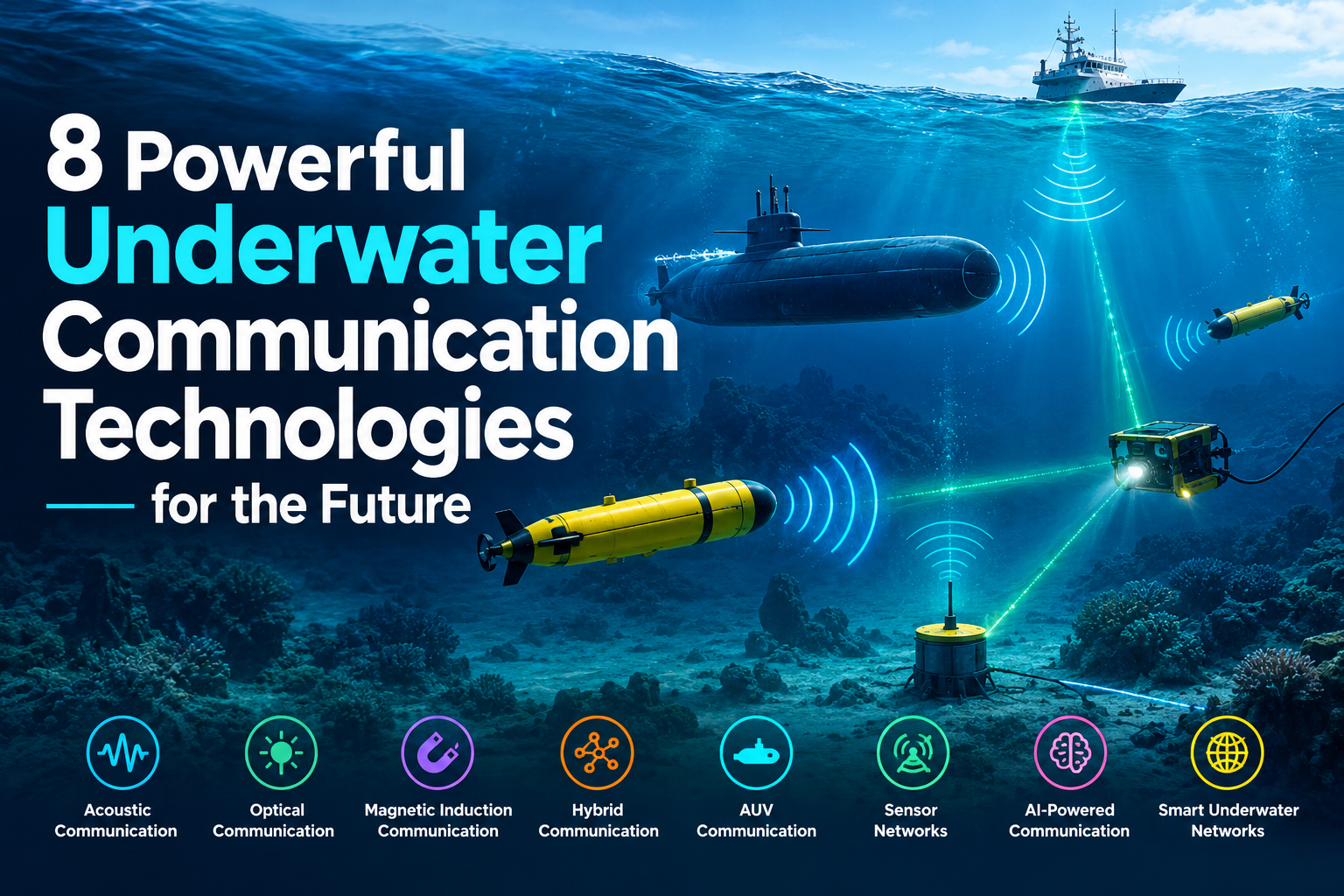
Underwater Communication Technologies are creating new ways for submarines, underwater robots, researchers, sensors, and marine systems to exchange information beneath the surface. Unlike normal wireless communication on land, underwater environments make communication difficult because radio signals do not travel efficiently through seawater. This has encouraged engineers to develop specialized using sound, light, magnetic fields, and other innovative methods.
As oceans become increasingly important for scientific research, offshore energy, marine security, environmental monitoring, and autonomous underwater vehicles, reliable communication is becoming more valuable. Modern can help underwater devices share measurements, coordinate operations, and transmit information in environments where traditional Wi-Fi and cellular networks cannot work effectively.
Table of Contents
- What Are Underwater Communication Technologies?
- Why Underwater Communication Technologies Matter
- Acoustic Underwater Communication Technologies
- Optical Underwater Communication Technologies
- Magnetic Induction Underwater Communication Technologies
- Hybrid Underwater Communication Technologies
- Underwater Communication Technologies for AUVs
- Underwater Communication Technologies for Ocean Monitoring
- AI and Smart Underwater Communication Technologies
- Challenges of Underwater Communication Technologies
- Future of Underwater Communication Technologies
What Are Underwater Communication Technologies?
Underwater Communication Technologies are systems designed to transmit information between devices operating below the water surface. These systems may transfer sensor readings, commands, navigation information, images, or other digital data between underwater machines and surface stations.
The underwater environment creates several challenges that do not normally exist in terrestrial communication. Water can absorb or weaken electromagnetic signals, visibility can be extremely limited, and pressure increases significantly with depth. Because of these conditions, underwater communication often requires specialized technologies that are designed around the physical properties of water.
Why Underwater Communication Technologies Matter
The importance of is increasing as more equipment moves beneath oceans, lakes, and other bodies of water. Autonomous underwater vehicles can explore areas without direct human access, while underwater sensors can continuously monitor temperature, pressure, currents, and marine conditions.
Without reliable communication, these systems may have difficulty sharing information or receiving instructions. Better underwater connectivity could allow multiple machines to coordinate their work, send data to researchers, and respond to changing conditions.
This makes relevant to marine science, offshore industries, environmental research, underwater robotics, and ocean exploration.
1. Acoustic Underwater Communication Technologies
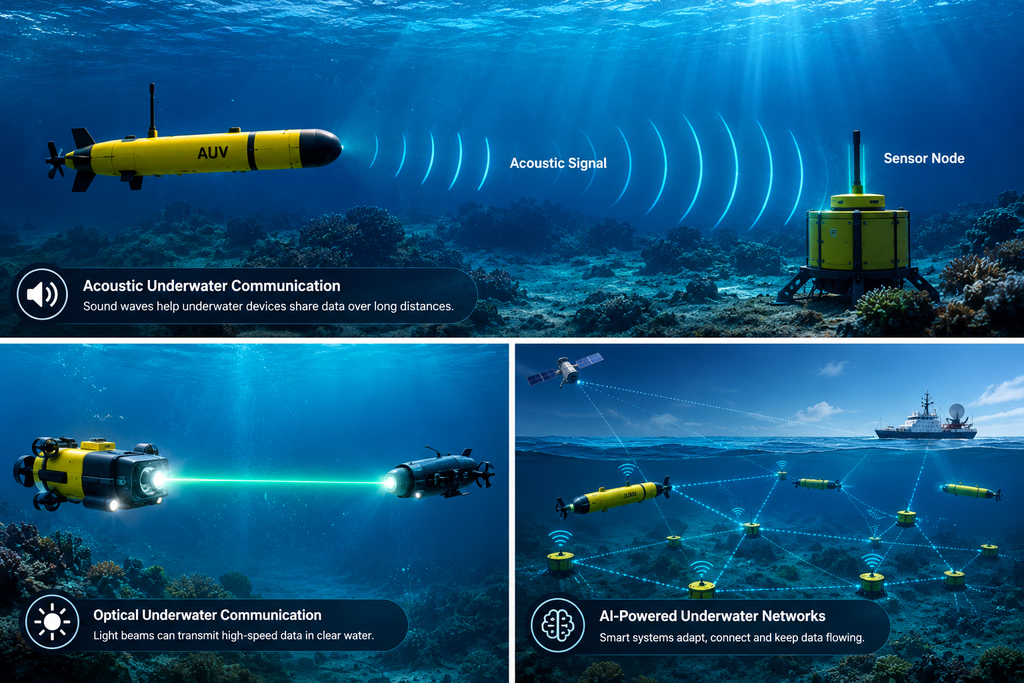
Acoustic systems are one of the most established forms Instead of relying on radio waves, these systems use sound waves to transmit information through water.
Sound can travel relatively long distances underwater, which makes acoustic communication useful for submarines, underwater sensors, and autonomous vehicles. A transmitter converts digital information into an acoustic signal, while a receiver detects and processes the signal.
The major advantage of acoustic communication is its ability to operate over relatively long underwater distances. However, the technology can have limited data rates, and reflections, background noise, changing water conditions, and multipath effects can complicate communication.
2. Optical Underwater Communication Technologies
Optical Underwater Communication Technologies use light to transfer information between underwater devices. Blue and green portions of the light spectrum can travel through clear water more effectively than many other wavelengths.
Optical communication can potentially provide much higher data rates than traditional acoustic systems over short distances. This makes it interesting for underwater robots that need to exchange large amounts of information, including images, sensor measurements, or other data.
The major limitation is range. Turbid water, particles, darkness, and obstacles can reduce the effectiveness of optical communication. As a result, optical systems are particularly useful when devices are relatively close to one another and the water conditions are suitable.
3. Magnetic Induction Underwater Communication Technologies
Magnetic induction is another emerging approach within Underwater Communication Technologies. These systems use magnetic fields to transmit information between specially designed coils.
One interesting feature of magnetic induction is that it can work in environments where conventional electromagnetic communication has limitations. The technology can be useful for short-range communication between underwater devices.
Researchers are exploring magnetic induction for underwater sensor networks, autonomous robots, and specialized communication systems. Its practical range and system design requirements remain important areas of engineering research.
4. Hybrid Underwater Communication Technologies
Hybrid Underwater Communication Technologies combine more than one communication method to overcome the limitations of individual systems. For example, an underwater network could use acoustic communication for long-distance connections and optical communication for high-speed short-range data transfer.
A hybrid system can select a suitable communication method depending on distance, water clarity, data requirements, and environmental conditions. This approach could become increasingly important as underwater networks become more complex.
Instead of depending on a single technology, future underwater systems may automatically switch between acoustic, optical, magnetic, and surface-based communication depending on what works best at a particular moment.
5. Underwater Communication Technologies for AUVs
Autonomous underwater vehicles, or AUVs, are an important application of Underwater Communication Technologies. These machines can operate underwater with limited or no direct human control, making communication essential for certain missions.
An AUV may need to exchange information with another underwater vehicle, a seabed sensor, or a surface station. Communication can support navigation updates, mission coordination, sensor data transfer, and operational commands.
Future AUV networks could involve multiple autonomous vehicles working together. In such systems, reliable underwater communication could allow machines to coordinate their activities instead of operating completely independently.
6. Underwater Communication Technologies for Ocean Monitoring
Ocean monitoring is another important area for Underwater Communication Technologies. Networks of underwater sensors can collect information about water temperature, pressure, salinity, currents, marine habitats, and other environmental conditions.
If these sensors can communicate efficiently, researchers can build a more detailed picture of changing underwater environments. Communication networks can also reduce the need for researchers to physically retrieve every sensor to collect stored information.
Future underwater sensor networks could operate for long periods while continuously exchanging selected measurements with nearby devices or surface systems.
7. AI and Smart Underwater Communication Technologies
Artificial intelligence could make Underwater Communication Technologies more adaptive. Underwater channels can change because of depth, temperature, movement, noise, and water conditions. AI algorithms could help communication systems identify these changes and adjust transmission strategies.
For example, an intelligent system could select different communication frequencies, transmission methods, or routes depending on the current environment. Machine learning could also help detect interference and improve how underwater networks manage available communication resources.
The combination of AI and underwater networking could eventually create systems that can make communication decisions with less human intervention.
8. Advanced Underwater Communication Technologies for Smart Networks
Future Underwater Communication Technologies may move beyond simple device-to-device connections toward large underwater networks. These networks could connect sensors, autonomous vehicles, underwater robots, research stations, and surface platforms.
A smart underwater network could allow information to move between different types of devices. An underwater sensor might send data to a nearby robot, the robot could forward the information to another node, and eventually the information could reach a surface station.
This type of multi-layer communication could make large-scale ocean monitoring and underwater automation more practical.
Underwater Communication Technologies Comparison
| Technology | Main Signal | Typical Strength | Main Challenge |
|---|---|---|---|
| Acoustic communication | Sound | Long underwater range | Lower data rates and noise |
| Optical communication | Light | High-speed data | Limited by water clarity |
| Magnetic induction | Magnetic field | Useful for short-range links | Limited communication distance |
| Hybrid communication | Multiple signals | Flexible performance | Greater system complexity |
| AUV communication | Acoustic/optical/magnetic | Supports autonomous missions | Mobility and changing conditions |
| Sensor networks | Multiple methods | Continuous monitoring | Power and connectivity |
| AI-assisted communication | Adaptive signals | Dynamic optimization | Computing and training requirements |
| Smart underwater networks | Mixed technologies | Large-scale connectivity | Network coordination |
Underwater Communication Technologies and Future Applications
The future applications of Underwater Communication Technologies could extend across several industries. Ocean researchers could use connected underwater sensors to collect environmental information, while offshore industries could use underwater robots to inspect equipment and structures.
Marine robotics could also benefit significantly. Multiple robots could exchange information and coordinate tasks without requiring constant surface intervention. This could support inspection, mapping, scientific exploration, and maintenance activities.
Another potential application is underwater infrastructure. As subsea energy systems, communication cables, scientific instruments, and other installations become more sophisticated, reliable communication could help monitor their condition and detect changes.
Illustrative Underwater Communication Technology Areas
The following chart is illustrative only. It shows relative technology characteristics for educational comparison, not measured market share or scientific performance rankings.
Challenges of Underwater Communication Technologies
Despite their potential, Underwater Communication Technologies face several difficult engineering problems. The underwater channel is highly variable, and communication performance can change depending on depth, temperature, salinity, pressure, particles, movement, and background noise.
Energy consumption is another major concern. Many underwater sensors and autonomous robots operate far from easily accessible power sources. Communication can consume a significant amount of energy, so future systems need efficient transmission methods that can operate for long periods.
Data rate is also an important challenge. Acoustic communication can support long-distance connections but generally has more limited bandwidth than many terrestrial wireless technologies. Optical communication can offer higher-speed transmission but may require clearer water and shorter distances.
Security is another emerging consideration. As underwater networks become more connected, protecting communication from interference, unauthorized access, or malicious manipulation will become increasingly important.
The Future of Underwater Communication Technologies
The future of Underwater Communication Technologies will likely involve multiple technologies working together rather than one universal communication method. Acoustic systems may continue to support longer-distance communication, while optical and magnetic systems can provide specialized short-range connections.
AI could also become increasingly important by helping underwater networks adapt to changing environmental conditions. Intelligent routing, automatic signal selection, and predictive communication management could improve network efficiency.
Advances in underwater robotics may accelerate this development. As autonomous vehicles become more capable, they will need communication systems that allow them to cooperate, exchange information, and respond to changing missions.
In the longer term, connected underwater environments could become more common. Instead of isolated underwater machines, oceans could contain networks of sensors and robots that continuously collect and exchange information.
Conclusion
Underwater Communication Technologies are creating new possibilities for connecting machines beneath the water surface, where conventional Wi-Fi and many terrestrial wireless systems cannot operate effectively. Acoustic, optical, magnetic, hybrid, and AI-assisted systems each provide different approaches to the unique challenges of underwater communication.
As underwater robotics, ocean monitoring, autonomous vehicles, and subsea infrastructure continue to develop, the demand for reliable communication will also grow. Although problems involving range, energy, data rates, noise, security, and environmental conditions remain, continued innovation could make underwater networks more capable and intelligent.
The future of Underwater Communication Technologies may ultimately be a connected underwater world where sensors, robots, and research systems can share information efficiently. Such connectivity could help scientists understand oceans better while enabling smarter and more autonomous underwater technologies.