
Power Cable Technologies are changing how electricity can be transmitted more efficiently across modern power networks. Traditional power cables have served electrical systems for decades, but growing electricity demand, renewable energy projects, electric vehicles, data centers, and smart grids are creating new challenges for transmission infrastructure. Modern Power Cable Technologies are helping engineers explore better materials, improved cooling methods, advanced monitoring systems, and smarter designs that can increase the usefulness of existing electrical networks.
The importance of efficient power transmission is growing as more electricity comes from renewable sources and digital infrastructure continues to expand. A power cable must carry electricity safely while managing heat, electrical losses, physical stress, and environmental conditions. New technologies are therefore focusing not only on making cables stronger but also on making them more efficient, easier to monitor, and better suited to future energy systems 9 Powerful Technologies Making Power Cables More Efficient.
Table of Contents
- What Are Power Cable Technologies?
- High-Performance Conductors
- Power Cable Technologies Using Advanced Materials
- High-Temperature Superconducting Cables
- Power Cable Technologies With Better Cooling
- Smart Monitoring Technologies
- Underground Power Cable Technologies
- High-Voltage Direct Current Cable Technologies
- Self-Monitoring Power Cables
- Future of Power Cable Technologies
- Conclusion
What Are Power Cable Technologies?
Power Cable Technologies include the materials, designs, monitoring systems, cooling methods, and engineering techniques used to improve electrical cables. The basic purpose of a power cable is to carry electrical energy from one location to another, but modern cables must handle increasingly demanding conditions 9 Powerful Technologies Making Power Cables More Efficient.
When electrical current passes through a conductor, some energy is converted into heat because of electrical resistance. This is one reason engineers continuously investigate better conductor materials and cable designs.
Modern Power Cable Technologies can focus on reducing electrical losses, managing heat, increasing transmission capacity, improving durability, and monitoring cable conditions. These improvements can become especially valuable in large electricity networks where even small efficiency improvements can have significant practical effects 9 Powerful Technologies Making Power Cables More Efficient.
High-Performance Conductors
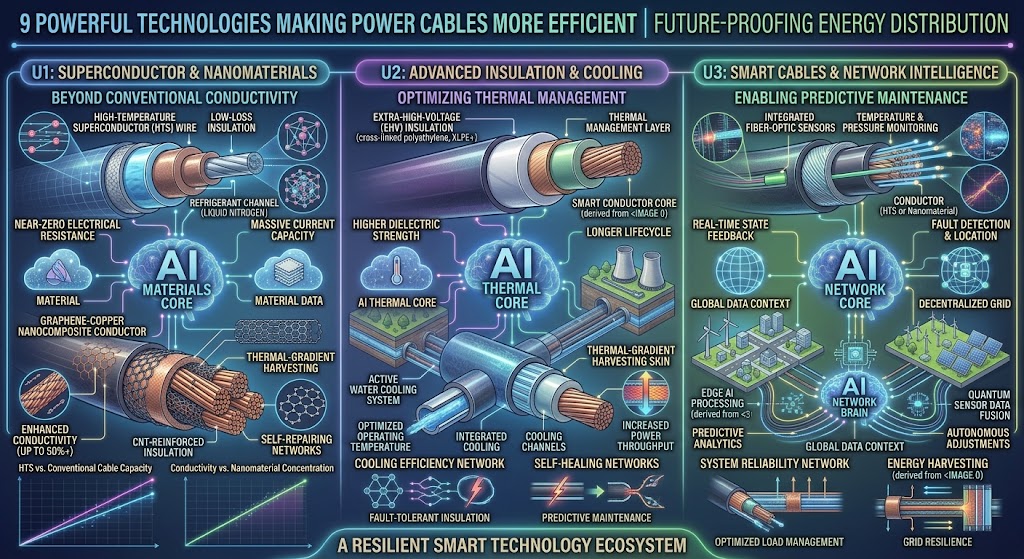
One of the most important areas of Power Cable Technologies is the development of conductors that can carry electricity efficiently. Copper and aluminum are widely used because of their useful electrical properties, but engineers continue to investigate advanced conductor designs and materials.
A conductor with lower electrical resistance can reduce energy losses during transmission. However, conductor performance is not determined only by electrical conductivity. Weight, cost, mechanical strength, temperature resistance, manufacturing requirements, and installation conditions are also important 9 Powerful Technologies Making Power Cables More Efficient.
This is why advanced conductor technologies often focus on finding a balance between electrical performance and practical engineering requirements.
Power Cable Technologies Using Advanced Materials
Advanced materials are opening another path for Power Cable Technologies. Researchers and engineers are investigating materials that can provide better electrical, thermal, mechanical, or environmental performance 9 Powerful Technologies Making Power Cables More Efficient.
For example, advanced insulation materials can help cables operate safely at high voltages. Better insulation can also improve reliability by reducing the risk of electrical breakdown.
Materials can also influence how easily a cable can be installed. A cable that is lighter or more flexible could potentially be easier to transport and position, particularly in difficult environments.
Power Cable Technologies and Material Efficiency
Material efficiency is becoming increasingly important as electricity networks expand. Engineers must consider not only how much electricity a cable can carry but also how much material is required to manufacture, transport, and install it 9 Powerful Technologies Making Power Cables More Efficient.
Future Power Cable Technologies may therefore combine highly conductive materials with lighter structures and improved insulation. The goal is to create cables that deliver strong electrical performance without unnecessary material use.
High-Temperature Superconducting Cables
Superconducting cables represent one of the more advanced areas of Power Cable Technologies. Superconductors can carry electrical current with extremely low electrical resistance when operated under suitable conditions 9 Powerful Technologies Making Power Cables More Efficient.
The major challenge is that superconducting materials generally require specialized cooling systems to reach their superconducting state. This makes them more complicated than conventional power cables.
Despite this challenge, superconducting cables have attracted interest for applications where high power density and efficient electricity transmission are particularly valuable.
Power Cable Technologies and Superconductivity
Superconducting Power Cable Technologies could become useful in locations where space is limited and large amounts of electricity need to be transmitted. Because superconducting systems can carry high current through relatively compact conductors, they may offer interesting possibilities for dense urban areas and specialized electrical infrastructure 9 Powerful Technologies Making Power Cables More Efficient.
However, cooling requirements, installation complexity, cost, and long-term reliability remain important engineering considerations.
Power Cable Technologies With Better Cooling
Heat is a major consideration in electrical cable design. When current flows through a conductor, resistance produces heat. If temperatures become too high, cable performance and lifespan can be affected 9 Powerful Technologies Making Power Cables More Efficient.
For this reason, improved cooling is an important part of Power Cable Technologies. Engineers can design cable systems that improve heat dissipation or use environmental conditions to help remove heat.
Underground cables, submarine cables, and densely packed electrical systems can have particularly challenging thermal conditions. Better thermal modeling can help engineers understand how cables behave under different loads and environmental conditions 9 Powerful Technologies Making Power Cables More Efficient.
Advanced Cooling for Power Cable Technologies
Advanced cooling approaches may involve improved cable structures, specialized materials, or active cooling systems in selected applications. The appropriate approach depends on the cable design and operating environment.
The purpose is not simply to make a cable colder. Effective thermal management can allow engineers to understand how much electrical current a cable can safely carry under particular conditions 9 Powerful Technologies Making Power Cables More Efficient.
Smart Monitoring Technologies
Modern Power Cable Technologies are increasingly connected with sensors and digital monitoring systems. Instead of waiting for a cable problem to become visible, engineers can use sensors to monitor conditions continuously.
Sensors can potentially measure temperature, vibration, electrical characteristics, and other indicators depending on the cable system. This information can then be analyzed to identify unusual changes 9 Powerful Technologies Making Power Cables More Efficient.
Smart monitoring can be especially valuable for large transmission networks because cables may extend over long distances and can be difficult to inspect manually.
Power Cable Technologies for Predictive Maintenance
Predictive maintenance uses information about equipment condition to help determine when inspection or maintenance may be needed. Power Cable Technologies combined with monitoring systems can provide engineers with more information about cable health.
For example, if a section of cable begins showing unusual thermal behavior, engineers may investigate the cause before the condition becomes more serious 9 Powerful Technologies Making Power Cables More Efficient.
This approach does not guarantee that every cable failure can be predicted. However, continuous monitoring can provide useful information that traditional periodic inspections may not capture.
Underground Power Cable Technologies
Underground transmission is another important area where Power Cable Technologies are developing. Underground cables can reduce visual impact and can be useful in locations where overhead transmission lines are difficult to install.
However, underground cables also create engineering challenges. Heat removal can be more difficult because the cable is surrounded by soil or other materials. Installation and maintenance can also require specialized equipment 9 Powerful Technologies Making Power Cables More Efficient.
Modern cable designs therefore focus on insulation, thermal performance, mechanical protection, and reliable installation methods.
Power Cable Technologies for Urban Areas
Dense cities can benefit from advanced underground Power Cable Technologies because available space is limited. Electricity demand can be high while new overhead transmission infrastructure may be difficult to install 9 Powerful Technologies Making Power Cables More Efficient.
Advanced underground cables can help engineers design electrical networks around existing roads, buildings, tunnels, and other infrastructure.
The challenge is balancing installation cost, maintenance requirements, thermal conditions, and long-term reliability.
High-Voltage Direct Current Cable Technologies
High-voltage direct current, commonly known as HVDC, is another important area of Power Cable Technologies. HVDC systems can be used to transmit electricity over long distances and are particularly relevant to some large-scale renewable energy projects 9 Powerful Technologies Making Power Cables More Efficient.
Compared with conventional alternating-current transmission, HVDC can have different technical characteristics and may be advantageous for certain long-distance transmission applications.
Submarine electricity links are one example where HVDC cable systems can be particularly useful. They can connect power networks across bodies of water and support the movement of electricity between regions.
Power Cable Technologies for Renewable Energy
The growth of wind and solar power is creating new requirements for electricity transmission. Renewable energy resources are not always located close to major population centers, so electricity may need to travel long distances.
HVDC Power Cable Technologies can play a role in connecting large renewable energy installations with distant electricity networks 9 Powerful Technologies Making Power Cables More Efficient.
This is particularly relevant to offshore wind projects, where submarine cables can transport generated electricity toward land-based grids.
Self-Monitoring Power Cables
One of the more interesting directions for Power Cable Technologies is the development of cables and cable systems that can provide information about their own condition.
Instead of treating a cable as a passive component, engineers can combine it with sensing technologies that provide information about temperature, physical stress, or other operating conditions 9 Powerful Technologies Making Power Cables More Efficient.
Distributed sensing systems can potentially monitor long sections of cable rather than relying on a small number of inspection points.
Power Cable Technologies and Fiber-Optic Sensing
Fiber-optic sensing is one technology that can support long-distance monitoring. Optical fibers can be integrated into or placed alongside cable systems and used to detect changes in physical conditions.
Depending on the sensing method, information about temperature or mechanical changes can be collected along the cable route.
This can help engineers locate areas that deserve further investigation without physically examining every section of a long transmission route 9 Powerful Technologies Making Power Cables More Efficient.
Power Cable Technologies Across Different Applications
| Technology Area | Main Purpose | Potential Advantage |
|---|---|---|
| Advanced Conductors | Improve electrical performance | Lower transmission losses |
| Advanced Materials | Improve cable construction | Better performance and durability |
| Superconducting Cables | Carry high currents | High power density |
| Advanced Cooling | Manage cable temperature | Better thermal performance |
| Smart Sensors | Monitor cable conditions | Earlier problem detection |
| Underground Cables | Deliver power below ground | Better use of urban space |
| HVDC Cables | Long-distance transmission | Efficient bulk transmission |
| Fiber-Optic Monitoring | Detect cable conditions | Continuous monitoring |
| Advanced Insulation | Protect high-voltage systems | Improved reliability |
Future of Power Cable Technologies
The future of Power Cable Technologies will likely depend on improvements in materials science, sensing, power electronics, manufacturing, and energy infrastructure.
As electricity demand increases, transmission networks will need to handle complex combinations of renewable generation, battery storage, electric vehicles, industrial loads, and digital infrastructure. This could increase the importance of cables that can carry electricity efficiently while also providing information about their operating condition 9 Powerful Technologies Making Power Cables More Efficient.
Artificial intelligence may also become more useful for cable monitoring. Large electrical networks can generate enormous amounts of sensor data, and AI-based systems could help engineers identify unusual patterns within that information.
Power Cable Technologies and Smart Grids
Smart grids require electrical infrastructure that can be monitored and managed using digital systems. Power Cable Technologies can become part of this transition by combining physical transmission infrastructure with sensors and communication systems.
A future cable network may not simply move electricity. It could also provide continuous information about temperature, loading, environmental conditions, and potential problems 9 Powerful Technologies Making Power Cables More Efficient.
This combination of power transmission and digital monitoring could make electrical infrastructure more responsive to changing demand.
Power Cable Technologies for a Renewable Future
Renewable energy is changing where electricity is generated. Solar farms, wind farms, offshore wind projects, and other energy systems can be located far from major demand centers.
This creates a growing need for transmission infrastructure capable of moving electricity over long distances. Advanced Power Cable Technologies can support this transition through improved conductors, HVDC systems, better insulation, thermal management, and monitoring technologies 9 Powerful Technologies Making Power Cables More Efficient.
The most suitable technology will depend on the distance, voltage level, environment, installation method, cost, and requirements of each project.
Conclusion
Power Cable Technologies are becoming increasingly important as electricity networks become larger, more connected, and more dependent on renewable energy. From advanced conductors and improved insulation to superconducting cables, smart sensors, underground systems, HVDC links, and fiber-optic monitoring, engineers are exploring many ways to improve modern power transmission.
The future of Power Cable Technologies is not only about carrying more electricity. It is also about reducing losses, managing heat, improving reliability, monitoring cable conditions, and adapting transmission infrastructure to new energy demands 9 Powerful Technologies Making Power Cables More Efficient.
As smart grids, renewable energy, electric transportation, and digital infrastructure continue to expand, advanced cable technology could become an increasingly important part of the global electricity system.