Street-Level Air Pollution Technologies are changing how cities understand the air people breathe every day. Traditional air-quality monitoring stations can provide valuable measurements, but they are usually installed at limited locations. Newer sensor networks, mobile monitoring systems, smart cameras, satellite data, and AI-powered platforms can help create a much more detailed picture of pollution across individual roads, neighborhoods, and busy urban areas. The U.S. Environmental Protection Agency notes that modern air sensors can be portable, relatively small, and capable of measuring pollutants such as particulate matter, nitrogen dioxide, and ozone, although sensor performance and calibration remain important considerations.
Street-level monitoring is becoming particularly important because pollution can change dramatically from one location to another. A busy intersection, bus stop, construction zone, or industrial road may have very different pollution conditions from a nearby residential street. Street-Level Air Pollution Technologies can help researchers and cities identify these local differences and understand where pollution is concentrated.
Table of Contents
- What Are Street-Level Air Pollution Technologies?
- Low-Cost Air Quality Sensor Networks
- Mobile Air Pollution Monitoring
- Smart Traffic Pollution Sensors
- AI-Powered Pollution Detection
- Optical Particle Sensors
- Gas-Sensing Technologies
- Drone-Based Air Pollution Monitoring
- Smart Cameras and Environmental Monitoring
- Satellite and Street-Level Data Integration
- Benefits and Limitations of Street-Level Monitoring
- Future of Street-Level Air Pollution Technologies
- Conclusion
What Are Street-Level Air Pollution Technologies?
Street-Level Air Pollution Technologies are tools designed to measure or estimate air pollution at locations close to where people live, walk, work, and travel. Instead of relying only on a few large monitoring stations, these technologies can create more detailed local measurements by combining small sensors, mobile platforms, wireless networks, artificial intelligence, cameras, and other data sources.
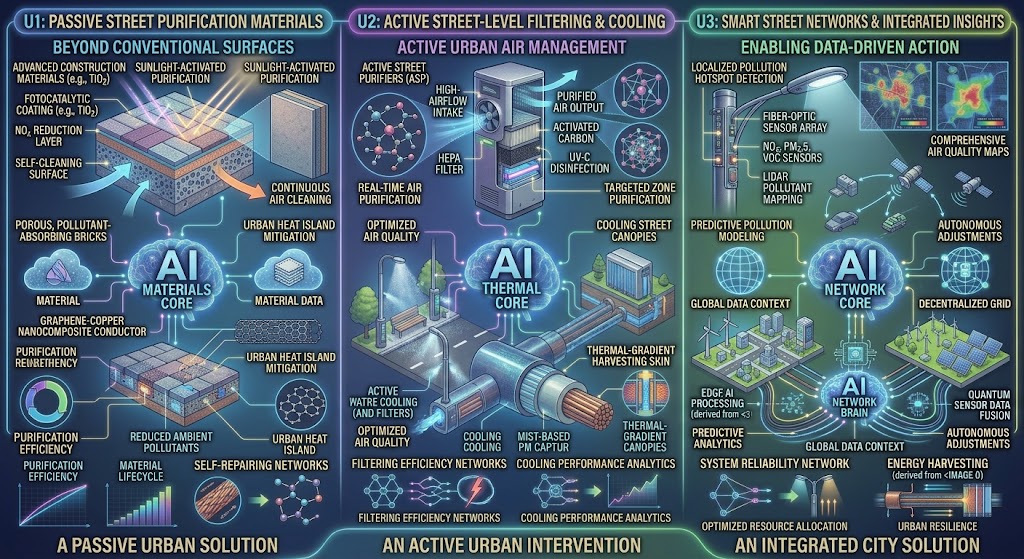
The pollutants being monitored can include particulate matter such as PM2.5 and PM10, nitrogen dioxide, ozone, carbon monoxide, and other gases. These pollutants can come from traffic, industrial activity, construction, fuel combustion, fires, and other sources. WHO identifies particulate matter, nitrogen dioxide, ozone, sulfur dioxide, and carbon monoxide among the major pollutants of public-health concern.
Low-Cost Street-Level Air Pollution Technologies
One of the biggest developments in Street-Level Air Pollution Technologies is the growing use of lower-cost air sensors. These devices can be installed in larger numbers than expensive reference monitoring equipment, potentially allowing cities and communities to collect information from many different locations.
Modern low-cost monitors may use one or several sensors to detect pollutants and environmental conditions such as temperature and humidity. EPA explains that these devices can expand the number of locations where air-quality information can be collected, but their readings should be interpreted carefully because performance can vary between sensors and environmental conditions.
This creates an interesting opportunity for low-competition environmental technology applications. A city could potentially place sensors near schools, major roads, markets, bus stations, or industrial areas to understand local pollution patterns instead of depending entirely on measurements from distant monitoring stations.
Mobile Street-Level Air Pollution Technologies
Mobile monitoring is another important development in Street-Level Air Pollution Technologies. Instead of permanently installing a sensor in one location, researchers can place monitoring equipment on cars, buses, bicycles, or other moving platforms.
As the vehicle travels through a city, the equipment can collect measurements from different streets. This can help researchers identify pollution hotspots that might be missed by stationary monitoring systems.
Mobile monitoring can be particularly useful around transportation corridors. Traffic-related pollution can change according to vehicle density, road design, weather conditions, and time of day. WHO identifies transportation as an important source of outdoor air pollution, particularly for pollutants such as nitrogen dioxide.
Smart Traffic Street-Level Air Pollution Technologies
Traffic sensors are becoming another useful part of Street-Level Air Pollution Technologies. These systems can combine pollution measurements with information about traffic volume, vehicle movement, speed, and congestion.
When pollution readings are connected with traffic information, researchers can investigate relationships between road activity and air quality. For example, a monitoring system might detect changes in nitrogen dioxide or particulate matter during periods of heavy congestion.
This type of technology can help cities understand whether particular intersections or road corridors require additional monitoring or traffic-management strategies. The technology does not automatically solve pollution, but it can provide more localized information for planning and research.
AI-Powered Street-Level Air Pollution Technologies
Artificial intelligence can make Street-Level Air Pollution Technologies more useful by analyzing large quantities of sensor data. A citywide network could produce thousands or millions of readings over time, making manual analysis difficult.
AI models can examine relationships between pollution measurements, weather, traffic, location, and time. When properly trained and validated, these systems can identify patterns and help estimate pollution conditions between monitoring points.
However, AI does not eliminate the need for reliable measurements. If the original sensor data are inaccurate or poorly calibrated, an advanced algorithm can still produce misleading results. EPA’s air-sensor guidance emphasizes planning, sensor performance evaluation, calibration, and appropriate interpretation of sensor data.
Optical Particle Street-Level Air Pollution Technologies
Optical particle sensors use light-based methods to estimate concentrations of airborne particles. These technologies are especially relevant for monitoring particulate matter, including PM2.5 and PM10.
A sensor can analyze how particles interact with light and use that information to estimate particle concentration. Small optical sensors can potentially be incorporated into portable or networked monitoring devices, making them useful for localized environmental measurements.
Particulate matter is particularly important because very small particles can penetrate deep into the lungs. WHO reports that PM2.5 can enter the bloodstream and is associated with cardiovascular and respiratory health effects.
Gas-Based Street-Level Air Pollution Technologies
Gas sensors are another major category of Street-Level Air Pollution Technologies. These sensors are designed to detect specific gases, including nitrogen dioxide, ozone, carbon monoxide, and other pollutants depending on the sensor type.
Gas monitoring can be valuable in areas where combustion-related pollution is a concern. Road traffic, industrial activity, and fuel-burning processes can release different gases into the atmosphere.
Portable gas sensors can make it possible to collect measurements from locations that are difficult to monitor with large fixed equipment. EPA has highlighted the use of portable air sensors for detecting outdoor pollutants such as particulate matter, nitrogen dioxide, and ozone.
Drone-Based Street-Level Air Pollution Technologies
Drones could provide another flexible platform for Street-Level Air Pollution Technologies. Instead of measuring pollution only at ground level, drones can carry lightweight environmental sensors and collect data at different locations or heights.
This can be useful for research around industrial facilities, construction areas, wildfire smoke, or difficult-to-access locations. A drone can potentially move through areas where installing permanent equipment would be expensive or impractical.
Drone monitoring also creates new research possibilities because pollution is not always distributed evenly vertically. Measurements at different heights can help researchers study how pollutants move through urban environments.
Smart Cameras and Street-Level Air Pollution Technologies
Cameras can add another layer of information to Street-Level Air Pollution Technologies. A smart environmental monitoring system could combine visual information with pollution sensors to understand what is happening around a monitoring location.
Computer vision systems can potentially identify traffic density, vehicle categories, construction activity, smoke, or other visible environmental conditions. When combined with actual sensor measurements, this information may help researchers investigate possible pollution sources.
The important distinction is that a camera does not directly measure every pollutant. Instead, it can provide contextual information that complements sensor measurements.
Satellite and Street-Level Air Pollution Technologies
Satellite observations can provide a large-scale view of atmospheric conditions, while Street-Level Air Pollution Technologies provide much more localized measurements. Combining these two data sources could create more detailed environmental models.
Satellite data can observe broad regional patterns, while ground-based sensors can capture conditions closer to people and roads. AI and geographic information systems can then combine different datasets to produce pollution maps.
This approach is especially interesting because air pollution is influenced by many factors, including weather, transportation, industrial activity, and local geography. WHO notes that outdoor pollution sources are location-specific and can include transportation, industry, power generation, construction, waste burning, and fires.
Street-Level Air Pollution Technologies by Application
| Technology | Main Purpose | Potential Street-Level Use |
|---|---|---|
| Low-cost sensors | Local pollution measurement | Roads and neighborhoods |
| Mobile sensors | Moving measurements | Traffic corridors |
| Gas sensors | Detect specific gases | Urban and industrial areas |
| Optical sensors | Measure particles | PM2.5 and PM10 monitoring |
| AI platforms | Analyze sensor data | Pollution mapping |
| Drones | Flexible monitoring | Hard-to-reach areas |
| Smart cameras | Environmental context | Traffic and source analysis |
| Satellite integration | Regional observation | Citywide pollution mapping |
Benefits of Street-Level Air Pollution Technologies
The biggest advantage of Street-Level Air Pollution Technologies is their ability to increase the spatial detail of air-quality information. Instead of having only a small number of monitoring locations, cities can potentially collect information from many more points.
These systems can also support community monitoring and research. EPA’s Enhanced Air Sensor Guidebook specifically provides guidance for organizations, researchers, communities, and other users interested in planning and conducting air-sensor monitoring projects.
Another advantage is flexibility. Small sensors can be mounted on vehicles, installed at selected locations, or incorporated into portable devices. This makes it easier to investigate temporary pollution events or specific areas.
Limitations of Street-Level Air Pollution Technologies
Despite their potential, Street-Level Air Pollution Technologies are not perfect. Sensor accuracy can vary, and environmental conditions such as temperature and humidity can affect measurements. EPA recommends careful sensor evaluation and calibration because accurate data depend on how sensors are selected, deployed, and maintained.
Another challenge is data management. A large network of sensors can generate huge amounts of information. Cities need appropriate systems for storing, validating, analyzing, and communicating those measurements.
For this reason, low-cost sensors should not automatically be treated as replacements for regulatory monitoring. Instead, they can complement established monitoring networks when properly designed and interpreted.
Future of Street-Level Air Pollution Technologies
The future of Street-Level Air Pollution Technologies will likely involve greater integration between sensors, AI, connected vehicles, drones, satellites, and digital maps. Instead of treating each monitoring device as an isolated instrument, future systems could combine multiple data sources into continuously updated pollution maps.
Smart-city infrastructure could eventually use these measurements to identify changing pollution conditions across neighborhoods. Connected transportation systems could provide traffic information, while environmental sensors provide pollution measurements and weather stations contribute atmospheric data.
The most important development may not be one individual sensor but the creation of connected environmental intelligence. As sensor costs, computing power, wireless connectivity, and data-analysis tools continue to develop, localized air-quality monitoring could become easier to deploy.
Conclusion
Street-Level Air Pollution Technologies are creating new ways to understand pollution where people actually experience it. Low-cost sensors, mobile monitoring, optical particle detection, gas sensors, AI, drones, smart cameras, and satellite integration can each contribute a different type of information.
The technology still requires careful calibration, validation, and responsible interpretation. However, when properly designed, Street-Level Air Pollution Technologies can help researchers and communities see pollution patterns at a much finer geographic scale than traditional monitoring alone. With continued improvements in sensors and data analytics, localized air-quality monitoring could become an important part of smarter and healthier urban environments.