Around-Corner Technologies are creating a new generation of machines that can detect objects and movement beyond a normal camera’s direct field of view. Instead of simply looking straight ahead, these technologies use reflected light, radio signals, LiDAR measurements, computational imaging, and advanced sensing algorithms to recover information from hidden areas. Researchers describe this broader field as non-line-of-sight, or NLOS, imaging and sensing.
The idea sounds futuristic, but research has already demonstrated systems capable of detecting or reconstructing hidden objects using indirect signals. In 2026, MIT researchers reported that consumer-grade LiDAR sensors could be used for around-the-corner imaging by exploiting motion and computational reconstruction.
This makes Around-Corner Technologies an interesting emerging technology topic because the goal is not simply to build better cameras. The goal is to give machines a form of indirect perception that can help them understand environments that are partially hidden.
Table of Contents
- What Are Around-Corner Technologies?
- How Around-Corner Technologies Work
- LiDAR Around-Corner Technologies
- Laser-Based Around-Corner Technologies
- RF and Radar Around-Corner Technologies
- Wi-Fi Around-Corner Technologies
- Shadow-Based Around-Corner Technologies
- Computational Imaging Around-Corner Technologies
- AI-Powered Around-Corner Technologies
- Around-Corner Technologies for Vehicles and Robots
- Comparison of Around-Corner Technologies
- Challenges of Around-Corner Technologies
- Future of Around-Corner Technologies
- Conclusion
What Are Around-Corner Technologies?
Around-Corner Technologies are sensing and imaging methods designed to gather information about objects that are not directly visible to a sensor. A conventional camera needs a direct optical path to see an object, but NLOS systems attempt to recover information from indirect signals.
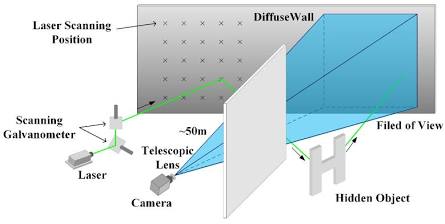
For example, a laser can illuminate a visible wall, with a small portion of the light scattering toward an unseen object. Some of that light can then return toward the visible wall and eventually reach a sensor. Computational algorithms can analyze the timing and intensity of these signals to estimate information about the hidden scene. Stanford researchers have demonstrated this type of approach using laser pulses and highly sensitive photon detection.
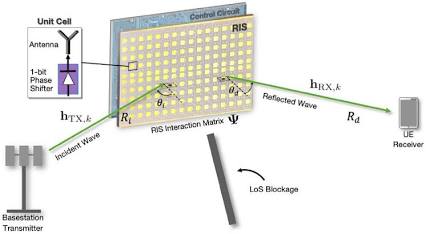
Other Around-Corner Technologies use radio-frequency signals rather than visible or near-infrared light. Because radio waves can interact differently with walls and objects, RF sensing can provide another way to detect movement or location when direct visibility is blocked. MIT research has specifically explored RF-based indoor localization around corners.
How Around-Corner Technologies Work
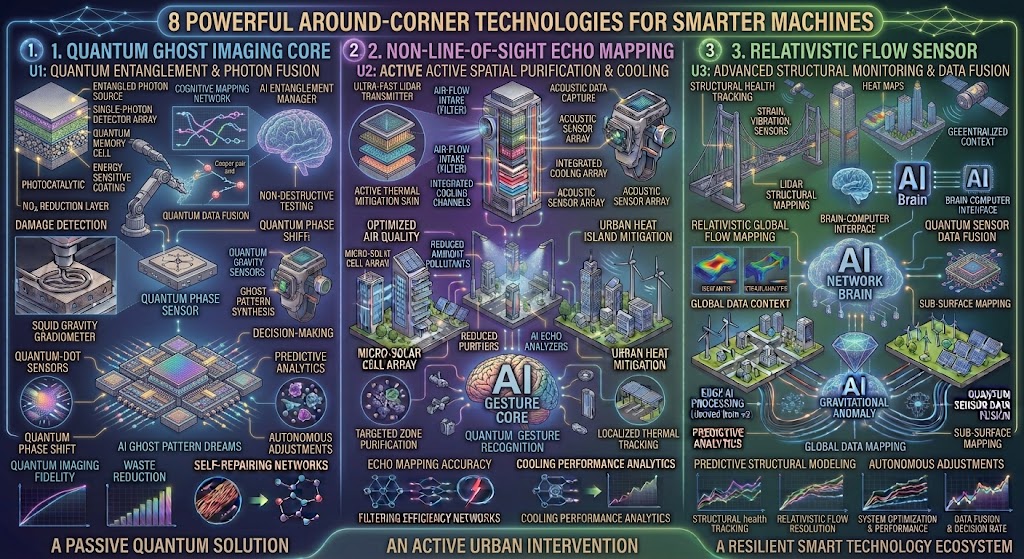
The basic principle behind many Around-Corner Technologies is indirect sensing. The sensor does not necessarily observe the hidden object directly. Instead, it observes a signal that has interacted with the environment.
Light, radio waves, or other signals can bounce, scatter, or reflect from surfaces. Sensors capture these changes, while computational algorithms attempt to reconstruct information about the hidden scene.
The challenge is that indirect signals are usually much weaker and more complicated than direct measurements. A wall, floor, object surface, lighting condition, and sensor position can all influence the signal.
Modern computational imaging helps solve part of this problem. Researchers can use mathematical models and algorithms to separate useful information from noisy measurements and reconstruct a representation of an otherwise hidden object or movement.
LiDAR Around-Corner Technologies
One of the most interesting developments in Around-Corner Technologies is the use of LiDAR. LiDAR normally measures distances by sending light pulses toward objects and measuring the returned signal. Researchers are now exploring how the same basic sensing hardware can be used to recover information outside a direct line of sight.
In 2026, MIT Media Lab researchers demonstrated an around-the-corner imaging approach using consumer-grade LiDAR. The system uses motion and a computational model to combine measurements over time and recover information about objects outside the camera’s direct field of view.
LiDAR Around-Corner Technologies for Smarter Machines
This approach is particularly interesting because LiDAR sensors are already found in some consumer electronics, spatial-computing devices, robots, and other systems. If similar hardware can perform additional sensing tasks through software, future machines may gain new perception capabilities without requiring an entirely separate sensor architecture.
The technology is still developing, and real-world performance depends on factors such as scene geometry, surface properties, sensor movement, and computational processing.
Laser-Based Around-Corner Technologies
Laser-based Around-Corner Technologies are among the most studied approaches to non-line-of-sight imaging. A laser can send controlled pulses toward a visible surface. Those pulses may scatter toward a hidden area and return through another indirect path.
Highly sensitive detectors can capture tiny amounts of returning light. Algorithms then analyze the timing of the detected photons to estimate the location or shape of objects that cannot be directly observed.
Stanford researchers have demonstrated laser-based systems capable of reconstructing hidden objects around corners, with computational algorithms playing a major role in converting weak reflected signals into useful information.
Advanced Laser Around-Corner Technologies
Earlier systems could require specialized equipment and significant processing time. Research has progressively focused on making these systems faster, more efficient, and capable of handling more complex environments.
Nature research has also demonstrated methods for detecting and tracking moving objects hidden around corners using non-line-of-sight laser ranging.
RF and Radar Around-Corner Technologies
Not every Around-Corner Technologies approach needs light. Radio-frequency sensing offers another route because RF signals can interact with indoor environments differently from visible light.
MIT’s CornerRadar research explored RF-based indoor localization around corners, showing how radio-frequency measurements can be used to estimate the location of people or devices when direct visibility is unavailable.
Radar systems can also detect motion, distance, and other characteristics without relying on a conventional optical image. Recent research continues to explore compact radar architectures for localization, gesture recognition, and environmental monitoring.
RF Around-Corner Technologies in Smart Environments
Future smart environments could use RF sensing to understand movement in areas where cameras have limited visibility. This could be useful for robots navigating indoor spaces, automated systems monitoring rooms, and machines that need additional environmental awareness.
Because RF sensing and optical sensing behave differently, combining them could provide complementary information.
Wi-Fi Around-Corner Technologies
Wi-Fi is normally associated with wireless communication, but researchers are increasingly investigating how wireless signals can also act as sensing information. This creates another interesting direction for Around-Corner Technologies.
Wi-Fi signals interact with people and objects as they travel through an environment. Changes in the signal can contain information about movement and location. Research has demonstrated non-contact human presence detection using Wi-Fi sensing.
Recent research has also investigated whether Wi-Fi signal-strength information can preserve motion-related signatures that can be extracted for sensing applications.
The major attraction is that Wi-Fi infrastructure is already widespread. Future systems could potentially combine communication and sensing capabilities, allowing connected environments to understand movement without depending entirely on visible cameras.
Shadow-Based Around-Corner Technologies
Another fascinating direction within Around-Corner Technologies involves shadows. Even when an object itself is hidden, it may affect light reaching a visible surface.
A camera can sometimes observe changes in a floor or wall caused by a hidden moving object. Algorithms can then analyze those changes to estimate movement.
Research has explored passive optical methods that use indirect visual information for non-line-of-sight detection. Nature Communications research has shown that scattered light can contain statistical information useful for detecting objects outside direct visibility.
This approach can be simpler in some environments, but it depends heavily on lighting, geometry, surface characteristics, and whether useful shadows or reflections are actually visible.
Computational Imaging Around-Corner Technologies
Computational imaging is one of the most important foundations behind Around-Corner Technologies. Sensors collect signals, but software is responsible for interpreting them.
Instead of producing a normal photograph, a computational imaging system may reconstruct a hidden scene from indirect measurements. This can involve signal processing, mathematical modeling, optimization, and increasingly sophisticated machine-learning techniques.
Stanford describes non-line-of-sight imaging as a field where computational methods can recover parts of a scene outside the direct line of sight.
AI and Computational Around-Corner Technologies
AI can potentially make reconstruction faster and more robust by learning patterns from large collections of sensor data. Instead of solving every reconstruction problem from scratch, trained models may help estimate hidden structures from incomplete information.
However, AI does not eliminate the physical limitations of the sensors. If the original signal contains very little useful information, software cannot simply guarantee a perfect reconstruction.
AI-Powered Around-Corner Technologies
AI-powered Around-Corner Technologies could eventually combine multiple sensor inputs and identify hidden movement in real time.
A future autonomous machine might combine LiDAR, radar, cameras, and wireless sensing. Each sensor could provide a different piece of information, while AI software could combine the data into a broader environmental model.
This approach is particularly useful because no single sensing method works perfectly in every environment. A visible camera can provide rich visual information, while radar may offer useful motion information and LiDAR can provide detailed distance measurements.
The combination could create machines that understand more of their surroundings than any single sensor could provide.
Around-Corner Technologies for Vehicles and Robots
Autonomous vehicles are one of the most frequently discussed applications of Around-Corner Technologies. A vehicle approaching a blind turn normally cannot see everything beyond the corner. A future NLOS sensing system could potentially provide additional information about objects outside the direct field of view.
Stanford researchers have specifically discussed the potential of around-corner imaging for autonomous driving, including the possibility of detecting hazards before they become visible to conventional sensors.
Robots could benefit in a similar way. A warehouse robot navigating around shelves might gain information about movement beyond an obstruction. Search-and-rescue robots could potentially use indirect sensing to detect activity behind obstacles, although practical deployment would depend on sensor limitations and environmental conditions.
Comparison of Around-Corner Technologies
| Around-Corner Technology | Main Signal | Main Strength | Potential Application |
|---|---|---|---|
| LiDAR sensing | Light pulses | Detailed distance information | Robots and vehicles |
| Laser NLOS imaging | Laser light | Hidden-scene reconstruction | Research and navigation |
| RF sensing | Radio waves | Works without optical visibility | Indoor localization |
| Radar sensing | Radio waves | Motion and distance detection | Vehicles and robotics |
| Wi-Fi sensing | Wireless signals | Uses communication infrastructure | Smart environments |
| Shadow sensing | Visible light | Passive indirect information | Motion detection |
| Computational imaging | Sensor data | Reconstructs hidden information | Advanced imaging |
| AI-assisted sensing | Multiple signals | Data fusion and interpretation | Autonomous machines |
The comparison shows why Around-Corner Technologies are becoming an interesting research area. Different approaches solve different sensing problems, and future systems may combine several of them instead of depending on only one.
Challenges of Around-Corner Technologies
Although Around-Corner Technologies sound highly advanced, several technical challenges remain. The biggest problem is signal quality. Indirect signals can become extremely weak after multiple reflections or scattering events.
Environmental conditions also matter. Walls, floors, furniture, reflective surfaces, lighting, weather, and object materials can all influence the measurements.
Another challenge is computational complexity. Reconstructing a hidden three-dimensional scene from indirect signals can require significant processing. Stanford research has highlighted the difficulty of recovering 3D structures from noisy NLOS measurements.
There are also safety and privacy considerations. Technologies capable of detecting hidden movement could have legitimate safety applications, but they may also raise questions about surveillance and appropriate use. Responsible deployment will therefore require clear technical and social safeguards.
Future of Around-Corner Technologies
The future of Around-Corner Technologies will likely involve smaller sensors, faster algorithms, better AI models, and stronger sensor fusion.
One particularly important direction is the use of consumer hardware. The 2026 MIT demonstration using consumer-grade LiDAR is significant because it shows how researchers are exploring capabilities beyond the original purpose of everyday sensing hardware.
Future machines may combine cameras, LiDAR, radar, RF sensing, and AI into a unified perception system. Instead of asking only, “What can the camera see?”, a machine could ask, “What information can I infer from the environment around me?”
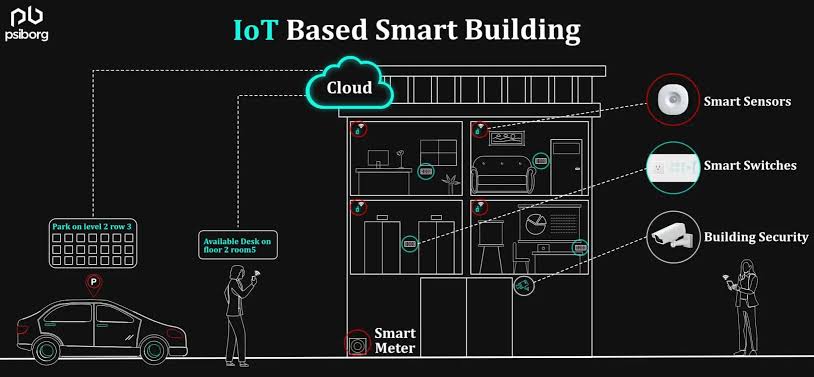
That shift could make Around-Corner Technologies useful in autonomous navigation, robotics, smart buildings, industrial monitoring, emergency response, and advanced computational imaging.
Conclusion
Around-Corner Technologies are pushing machine perception beyond traditional direct vision. LiDAR, laser sensing, radar, RF signals, Wi-Fi, computational imaging, and AI are creating different ways to gather information about objects that are hidden from ordinary cameras.
The technology is still developing, and many systems remain experimental or specialized. However, current research demonstrates that indirect signals can contain surprisingly useful information about hidden scenes.
As sensors become smaller and algorithms become faster, Around-Corner Technologies could become an important part of future machines that need greater environmental awareness. The most interesting possibility is not simply a camera that sees around a corner, but a smarter machine that can combine multiple invisible signals to understand what may be happening beyond its immediate view.