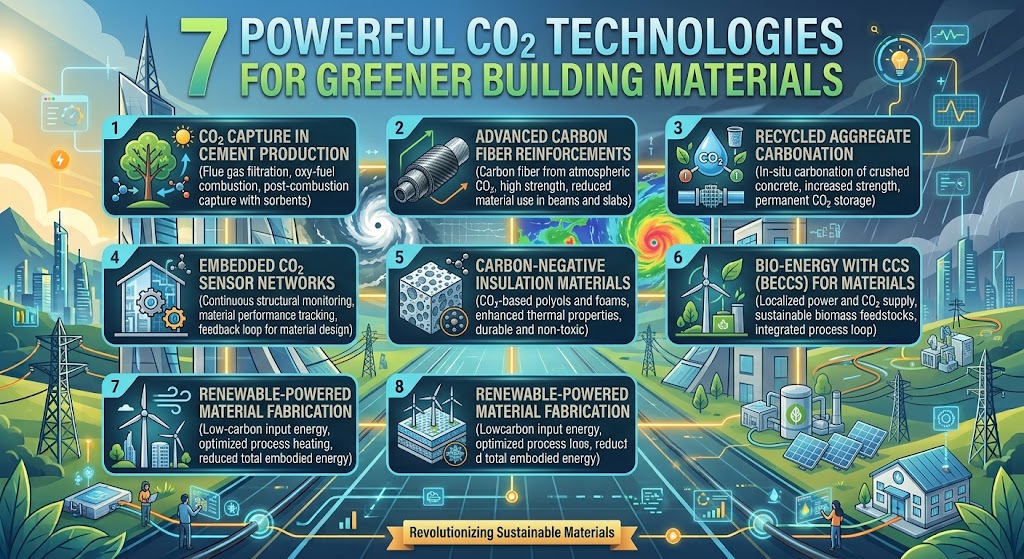
CO₂ Building Materials are becoming an emerging area of construction technology as researchers look for ways to use captured carbon dioxide in concrete, aggregates, binders, and other construction products. Instead of treating CO₂ only as a waste emission, new technologies can transform it into stable carbonate materials that can become part of building products. Carbon mineralization is particularly interesting because CO₂ can react with calcium- or magnesium-rich materials to form stable carbonates 7 Powerful CO₂ Technologies for Greener Building Materials.
This technology creates an unusual connection between carbon management and construction. It also offers a relatively low-competition topic for technology-focused websites because CO₂ Building Materials combine carbon capture, materials science, concrete technology, recycling, and sustainable construction in one emerging niche.
Table of Contents for CO₂ Building Materials
- What Are CO₂ Building Materials?
- CO₂-Cured Concrete and CO₂ Building Materials
- Carbon-Mineralized Aggregates and CO₂ Building Materials
- Carbonated Industrial Waste and CO₂ Building Materials
- CO₂ Mineralization in Cement Materials
- Recycled Concrete and CO₂ Building Materials
- Carbonated Bricks and Blocks as CO₂ Building Materials
- Mineral-Based CO₂ Building Materials
- Benefits and Challenges of CO₂ Building Materials
- Future of CO₂ Building Materials
What Are CO₂ Building Materials?
CO₂ Building Materials are construction materials produced using carbon dioxide as an input, curing agent, or mineralization source. The basic idea is to make CO₂ react with suitable minerals so that it becomes part of a solid carbonate rather than remaining in gaseous form 7 Powerful CO₂ Technologies for Greener Building Materials.
The U.S. Department of Energy describes carbon mineralization as a pathway in which CO₂ reacts with alkaline materials to produce products such as synthetic aggregates, bicarbonates, and building materials. Carbonate formation can provide a relatively durable way of storing CO₂ in construction products.
The technology does not mean that every piece of concrete automatically becomes carbon-negative. The environmental result depends on factors such as the CO₂ source, capture energy, transportation, material composition, manufacturing process, and final product performance. Research has specifically highlighted the importance of evaluating the complete life cycle rather than looking only at the amount of CO₂ injected into concrete 7 Powerful CO₂ Technologies for Greener Building Materials.
CO₂ Cured Concrete and CO₂ Building Materials
One of the best-known approaches to CO₂ Building Materials is CO₂ curing. In this process, captured carbon dioxide can be introduced during the curing of certain concrete products. The CO₂ reacts with calcium-containing components and forms calcium carbonate inside the material.
This process can potentially store carbon in a solid form while changing the properties of the concrete. CO₂ curing is particularly suited to controlled manufacturing environments such as precast concrete production because curing conditions can be carefully managed 7 Powerful CO₂ Technologies for Greener Building Materials.
The International Energy Agency has identified CO₂-cured concrete as one of the more mature applications of CO₂ utilization in building materials. It also explains that CO₂ can be incorporated into concrete through curing or used as a raw material for cement and aggregates.
How CO₂ Curing Works in CO₂ Building Materials
During CO₂ curing, carbon dioxide is introduced to a suitable concrete product under controlled conditions. Calcium-containing compounds react with the CO₂ and form carbonate minerals. The resulting carbonate becomes incorporated into the solid material.
The exact amount of CO₂ that can be absorbed varies according to the formulation, curing conditions, CO₂ concentration, and other process factors. Therefore, CO₂ curing should be considered a specific manufacturing technology rather than a universal solution for every type of concrete 7 Powerful CO₂ Technologies for Greener Building Materials.
Carbon-Mineralized Aggregates and CO₂ Building Materials
Another promising category of CO₂ Building Materials involves producing aggregates through carbon mineralization. Aggregates are essential components of concrete, and researchers are investigating whether waste materials and mineral-rich industrial residues can react with CO₂ to create useful construction aggregates.
The DOE’s carbon mineralization pathway includes synthetic aggregates and construction materials among its areas of development. Researchers are also investigating alkaline sources such as mining wastes and industrial materials as possible feedstocks 7 Powerful CO₂ Technologies for Greener Building Materials.
This approach could connect two waste-management problems. Instead of sending certain mineral-rich waste streams to storage or disposal, they may potentially be processed into construction materials while incorporating CO₂.
Recycled Materials in CO₂ Building Materials
Recycled concrete fines are another area of research. Studies have examined the mineralization of recycled concrete-derived materials, showing that carbonation can transform calcium-rich recycled material into carbonated products with potential construction applications.
This creates a circular-material concept in which old concrete can become part of a new material while also interacting with captured CO₂ 7 Powerful CO₂ Technologies for Greener Building Materials.
Carbonated Industrial Waste and CO₂ Building Materials
Industrial waste can become another important ingredient in CO₂ Building Materials. Some industrial residues contain calcium, magnesium, or other components that can react with carbon dioxide.
Materials such as certain slags, waste-derived mineral streams, and other alkaline residues have been investigated for mineral carbonation. The IEA notes that CO₂ can react with minerals or waste streams to form carbonates that can be incorporated into construction materials 7 Powerful CO₂ Technologies for Greener Building Materials.
The advantage is potentially twofold: a waste stream can be converted into a useful material, while captured CO₂ becomes incorporated into the resulting product.
However, industrial waste is not automatically suitable for construction. Chemical composition, contaminants, processing requirements, durability, and regulatory standards all need to be considered before a material can be used safely in buildings or infrastructure 7 Powerful CO₂ Technologies for Greener Building Materials.
CO₂ Mineralization in Cement Materials
Mineralization is at the heart of many CO₂ Building Materials technologies. Instead of simply storing gaseous CO₂, mineralization converts it into solid carbonate compounds.
Recent 2026 research describes mineral carbonation as a pathway for durable CO₂ storage and highlights the importance of understanding reaction mechanisms, material design, and process engineering before large-scale deployment 7 Powerful CO₂ Technologies for Greener Building Materials.
A 2026 review also compares calcium- and magnesium-rich precursors and examines how carbonation affects microstructure, mechanical properties, durability, energy requirements, and CO₂ uptake.
This is important because a construction material must do more than absorb carbon. It must also meet performance requirements for its intended application.
Recycled Concrete and CO₂ Building Materials
Recycling is becoming an important part of the future of CO₂ Building Materials. Concrete is produced on a massive scale, so even relatively small improvements in material efficiency can have significant implications 7 Powerful CO₂ Technologies for Greener Building Materials.
Researchers have investigated carbonation of recycled concrete fines as a method for incorporating CO₂ into recycled mineral materials. Experimental research has demonstrated that carbonated recycled fines can develop properties relevant to cementitious applications.
The long-term opportunity is a circular construction system where demolished concrete is processed, mineral components are recovered, CO₂ is incorporated through carbonation, and the resulting materials are returned to construction.
This could reduce the need for some virgin mineral resources while giving captured CO₂ a useful destination 7 Powerful CO₂ Technologies for Greener Building Materials.
Carbonated Bricks and Blocks as CO₂ Building Materials
Bricks, blocks, panels, and precast products could also become part of the CO₂ Building Materials landscape. These products are attractive candidates for carbon utilization because their manufacturing can often take place in controlled environments.
Controlled production makes it easier to manage temperature, humidity, pressure, CO₂ concentration, and curing time. These conditions can help manufacturers study how carbonation influences strength and durability.
The IEA has noted that early markets for CO₂ use in concrete and building materials have emerged, while additional testing remains important for wider deployment 7 Powerful CO₂ Technologies for Greener Building Materials.
Future carbonated blocks could potentially combine recycled mineral feedstocks with captured CO₂, creating products that address both waste reduction and carbon utilization.
Mineral-Based CO₂ Building Materials
Mineral-based CO₂ Building Materials may eventually extend beyond traditional concrete. Calcium- and magnesium-rich materials can react with CO₂ to form stable carbonate minerals, opening possibilities for different construction products.
Research into mineral carbonation is exploring the relationship between the chemical reaction, resulting microstructure, material strength, durability, and long-term carbon storage 7 Powerful CO₂ Technologies for Greener Building Materials.
This means future construction materials could be designed around carbonation from the beginning. Instead of adding CO₂ as an afterthought, manufacturers could engineer materials specifically to maximize useful mineralization while maintaining required performance.
CO₂ Building Materials Technology Comparison
| CO₂ Building Materials Technology | Main Input | Potential Application |
|---|---|---|
| CO₂ Curing | Captured CO₂ + concrete | Precast concrete |
| Carbonated Aggregates | Minerals + CO₂ | Concrete aggregates |
| Waste Mineralization | Industrial waste + CO₂ | Construction materials |
| Recycled Concrete Carbonation | Recycled concrete + CO₂ | New cementitious products |
| Carbonated Blocks | CO₂ + mineral materials | Blocks and masonry |
| Carbonated Binders | Calcium/Magnesium materials + CO₂ | Low-carbon binders |
| Mineral Carbonation | Alkaline minerals + CO₂ | Long-term carbon storage |
Illustrative Potential of CO₂ Building Materials
The chart below is illustrative only. It is not a scientific performance ranking or measured market-share dataset. It shows different areas where CO₂ utilization can conceptually contribute to construction.
The visualization highlights the range of approaches rather than claiming that one technology is scientifically superior to another 7 Powerful CO₂ Technologies for Greener Building Materials.
Benefits of CO₂ Building Materials
One potential benefit of CO₂ Building Materials is durable carbon storage. When CO₂ reacts with suitable minerals and becomes carbonate, the carbon can remain incorporated in the solid material for long periods. The DOE identifies carbonate materials as an effective long-term storage option, particularly when used in construction applications 7 Powerful CO₂ Technologies for Greener Building Materials.
Another potential benefit is resource efficiency. Some approaches can combine captured CO₂ with industrial waste or recycled construction materials, creating opportunities to replace part of the demand for virgin materials.
CO₂ utilization can also create new manufacturing pathways for the construction industry. Instead of viewing captured carbon only as something that must be stored underground, manufacturers can investigate whether a portion can become a feedstock for useful products.
Challenges of CO₂ Building Materials
Despite the potential, CO₂ Building Materials still face important challenges. Capturing carbon dioxide requires energy, and transporting it to a manufacturing facility can also create emissions. If these factors are ignored, a technology can appear more climate-friendly than it actually is 7 Powerful CO₂ Technologies for Greener Building Materials.
A detailed Nature Communications study of CO₂ curing and mixing in concrete found that the net climate benefit varies substantially across experimental cases and depends on factors such as CO₂ capture, transport, energy use, and changes in concrete strength.
Performance is another challenge. Construction materials must satisfy requirements for strength, durability, fire behavior, moisture resistance, safety, and long-term stability. New materials therefore require testing and appropriate standards before they can be widely used in structural applications.
Cost is also important. A technology must compete with established concrete and aggregate manufacturing systems while maintaining reliable quality 7 Powerful CO₂ Technologies for Greener Building Materials.
Future of CO₂ Building Materials
The future of CO₂ Building Materials will likely involve a combination of carbon capture, mineral processing, recycling, and advanced materials engineering.
One important direction is integrating CO₂ capture directly with mineralization facilities. The DOE identifies integration of carbon capture with mineral carbonation as an area for further research.
Another direction is improving the use of waste minerals. If industrial residues can be processed efficiently, they could provide both a feedstock for construction and a pathway for carbon storage 7 Powerful CO₂ Technologies for Greener Building Materials.
Digital monitoring could also become important. Sensors and data systems may help manufacturers control carbonation conditions and verify the consistency of resulting materials.
Rather than one universal material replacing conventional concrete, the future may involve several specialized CO₂ Building Materials, each designed for a particular application.
Why CO₂ Building Materials Matter
The construction industry uses enormous quantities of materials, making even small improvements potentially significant at scale. Recent research has emphasized the enormous resource demand associated with global concrete production and the need to improve material efficiency.
CO₂ Building Materials offer an interesting technological approach because they connect carbon management with one of the world’s largest material industries 7 Powerful CO₂ Technologies for Greener Building Materials.
The most important point is that carbon utilization should not automatically be considered carbon reduction. The complete life cycle needs to be evaluated, including capture, transport, energy use, manufacturing, product performance, and long-term storage.
Conclusion on CO₂ Building Materials
CO₂ Building Materials are opening a new direction in construction technology by turning captured carbon dioxide into a potential ingredient for concrete, aggregates, binders, recycled materials, and other construction products.
CO₂ curing, mineralized aggregates, industrial-waste carbonation, recycled concrete carbonation, carbonated blocks, advanced binders, and mineral carbonation are all being explored as pathways toward more resource-efficient construction 7 Powerful CO₂ Technologies for Greener Building Materials.
The technology is still developing, and its real environmental value depends on how efficiently CO₂ is captured, processed, transported, and permanently incorporated into useful products. Nevertheless, recent research shows that mineralization and carbon-based construction materials are becoming an important area of materials science and low-carbon construction research.
For technology websites looking for a low-competition and future-focused topic, CO₂ Building Materials provide a distinctive combination of climate technology, construction innovation, recycling, and advanced materials research 7 Powerful CO₂ Technologies for Greener Building Materials.