Air-Purifying Paint Technologies are creating a new direction in building materials by turning ordinary painted surfaces into functional air-cleaning surfaces. Instead of using paint only for decoration and protection, researchers and manufacturers are developing coatings that can interact with pollutants, moisture, light, and harmful chemicals in the surrounding environment. This makes Air-Purifying Paint Technologies an interesting low-competition technology topic connecting construction, materials science, environmental engineering, and indoor air quality.
Some advanced coatings use photocatalytic materials that can react with pollutants when exposed to suitable light. Others use mineral-based materials, porous structures, antimicrobial ingredients, or specialized chemical systems designed for particular environments. The actual effectiveness depends heavily on the coating formulation, pollutant, lighting conditions, ventilation, humidity, and surface area.
Table of Contents for Air-Purifying Paint Technologies
- What Are Air-Purifying Paint Technologies?
- Photocatalytic Air-Purifying Paint Technologies
- Titanium Dioxide Air-Purifying Paint Technologies
- Mineral-Based Air-Purifying Paint Technologies
- VOC-Reducing Air-Purifying Paint Technologies
- Smog-Reducing Air-Purifying Paint Technologies
- Antimicrobial Air-Purifying Paint Technologies
- Porous Air-Purifying Paint Technologies
- Smart Sensor-Integrated Air-Purifying Paint Technologies
- Benefits and Limitations of Air-Purifying Paint Technologies
- Future of Air-Purifying Paint Technologies
What Are Air-Purifying Paint Technologies?
Air-Purifying Paint Technologies refer to specialized coatings designed to interact with certain airborne pollutants or contaminants. Conventional paint mainly provides color, surface protection, and aesthetic value. Air-purifying coatings attempt to provide an additional functional property.
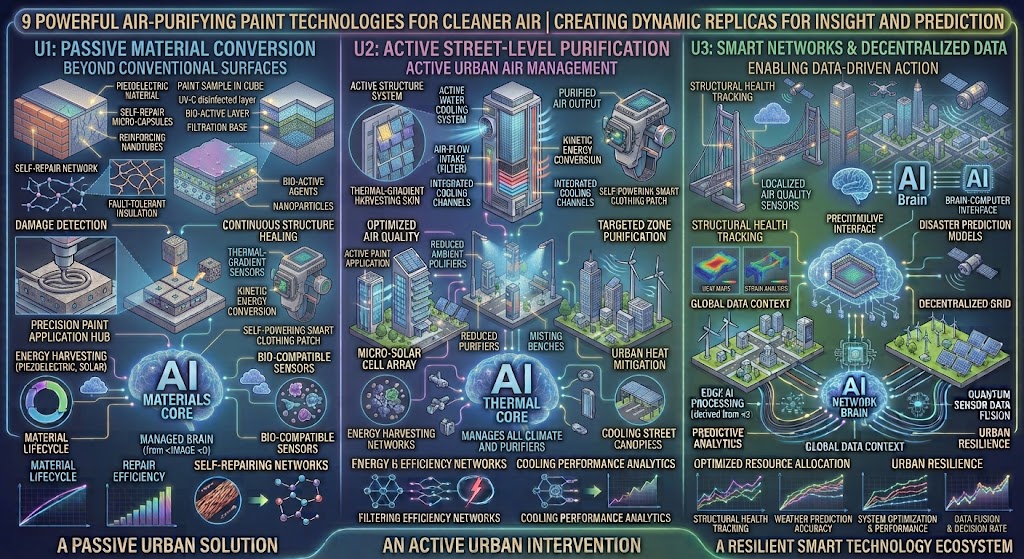
The technology can work through several mechanisms. A photocatalytic coating may use light to activate a catalyst that helps break down certain pollutants. A porous coating may provide a large reactive surface, while another formulation may use chemical compounds capable of interacting with specific volatile organic compounds.
It is important to understand that these paints do not automatically clean all indoor or outdoor pollution. Their performance depends on the chemistry of the coating and the conditions where it is used.
This distinction is important for anyone researching Air-Purifying Paint Technologies, because marketing claims can sometimes be broader than what controlled scientific testing demonstrates.
Photocatalytic Air-Purifying Paint Technologies
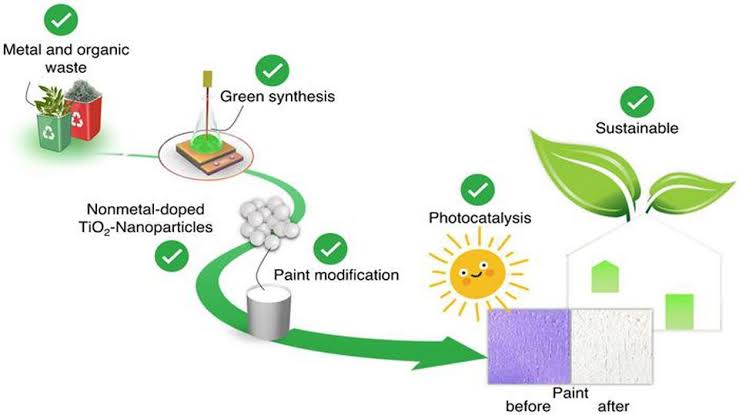
One of the most studied categories of Air-Purifying Paint Technologies uses photocatalysis. In simple terms, a photocatalyst uses light energy to accelerate chemical reactions on a surface.
When appropriate light reaches a photocatalytic coating, reactive species can form at the surface. These species may interact with certain organic compounds and other pollutants, breaking them into smaller compounds under suitable conditions.
This technology has attracted attention for walls, façades, tiles, roads, tunnels, and other surfaces because the coating can operate directly on the exposed material.
How Photocatalytic Air-Purifying Paint Technologies Work
Photocatalytic Air-Purifying Paint Technologies generally depend on three important elements: a suitable catalyst, a light source, and contact between pollutants and the coated surface.
Titanium dioxide is one of the best-known photocatalytic materials. Under appropriate ultraviolet light, titanium dioxide can generate highly reactive species that participate in oxidation reactions.
However, real-world performance can differ significantly from laboratory experiments. Light intensity, humidity, pollutant concentration, surface contamination, and coating durability can all affect results.
Titanium Dioxide Air-Purifying Paint Technologies
Titanium dioxide has become a major material in research involving Air-Purifying Paint Technologies because it is widely used as a white pigment and can also function as a photocatalyst.
Photocatalytic titanium dioxide coatings have been investigated for reducing certain pollutants on building surfaces. The basic concept is attractive because the coating can remain on a wall or other surface while light activates the photocatalytic process.
Researchers have also explored modified titanium dioxide materials designed to respond to a wider portion of the light spectrum. This is important because conventional photocatalytic titanium dioxide performs most effectively under ultraviolet radiation.
Modified Titanium Dioxide Air-Purifying Paint Technologies
Scientists are investigating ways to improve titanium dioxide photocatalysis by modifying the material’s structure or combining it with other compounds. The objective can be to improve light utilization, reaction efficiency, or pollutant degradation.
These developments could make Air-Purifying Paint Technologies more practical in environments where direct ultraviolet exposure is limited.
However, improving laboratory activity does not necessarily guarantee better real-world air cleaning. Long-term testing remains important because building surfaces experience dust, weather, aging, and changing environmental conditions.
Mineral-Based Air-Purifying Paint Technologies
Mineral-based coatings represent another interesting category of Air-Purifying Paint Technologies. Certain minerals can interact with moisture, pollutants, or gases because of their chemical structure and surface properties.
Some mineral materials are naturally porous and can provide substantial surface area for chemical reactions. This makes them attractive for coatings designed to interact with indoor pollutants.
Mineral-based systems may also offer other properties such as moisture regulation or improved surface durability, depending on the formulation.
The major advantage of this approach is that researchers can potentially engineer the coating around a specific environmental function rather than relying solely on conventional paint chemistry.
VOC-Reducing Air-Purifying Paint Technologies
Volatile organic compounds, commonly called VOCs, are another target for Air-Purifying Paint Technologies. VOCs can originate from paints, adhesives, cleaning products, furniture, solvents, and other household or industrial sources.
Some specialized coatings are designed to reduce certain VOCs through adsorption or chemical reactions. The objective is to capture or transform pollutants that might otherwise remain in indoor air.
This technology is particularly interesting because indoor environments can contain many different chemical compounds, and not every coating reacts with every pollutant.
For this reason, a coating should be evaluated according to the specific compounds it has been tested against rather than assuming it removes all VOCs.
Smog-Reducing Air-Purifying Paint Technologies
Outdoor applications are creating another research direction for Air-Purifying Paint Technologies. Large surfaces such as building façades, tunnels, walls, and pavements could potentially provide areas where photocatalytic coatings interact with selected air pollutants.
Nitrogen oxides are among the pollutants that have been investigated in connection with photocatalytic surfaces.
The idea is especially interesting in cities because buildings contain enormous surface areas. If functional coatings can perform reliably on these surfaces, they could become part of broader urban pollution-control strategies.
However, coatings should be viewed as one possible supporting technology rather than a replacement for emission controls at vehicles, factories, power plants, and other major pollution sources.
Antimicrobial Air-Purifying Paint Technologies
Some Air-Purifying Paint Technologies also overlap with antimicrobial coatings. These surfaces may contain materials designed to inhibit the growth or survival of certain microorganisms on the coated surface.
Antimicrobial functionality is different from removing airborne pollutants, but combining multiple surface functions can make coatings more useful in certain environments.
Hospitals, laboratories, schools, public transportation facilities, and high-traffic buildings may have different requirements from ordinary residential walls.
The challenge is developing coatings that maintain their antimicrobial or air-quality functions without creating unwanted chemical emissions or compromising surface durability.
Porous Air-Purifying Paint Technologies
Porosity can make a major difference in Air-Purifying Paint Technologies because a porous surface can provide more area for interactions between the coating and surrounding air.
A porous coating can potentially trap or adsorb certain molecules. When combined with catalytic materials, the surface may also provide locations where chemical reactions can occur.
Researchers can manipulate particle size, pore structure, surface chemistry, and coating thickness to change how the material behaves.
This creates an exciting materials-engineering opportunity. Instead of designing paint simply as a colored liquid that becomes a solid film, scientists can design the microscopic structure of the final surface for a specific environmental purpose.
Smart Sensor-Integrated Air-Purifying Paint Technologies
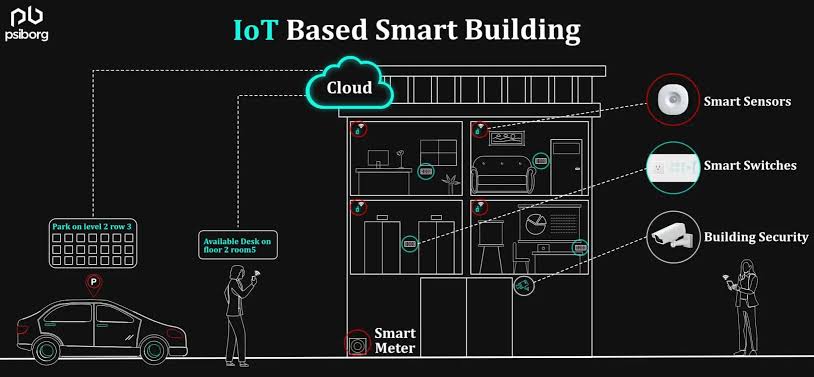
A future direction for Air-Purifying Paint Technologies could involve combining functional coatings with sensors and smart building systems.
Sensors can monitor environmental conditions such as humidity, temperature, and selected pollutants. Data from these sensors could help determine whether a coating is operating under suitable conditions.
For example, a building-management system could monitor indoor air quality while tracking environmental conditions around functional surfaces.
The paint itself does not necessarily need to contain electronics. Instead, functional coatings and external sensors can work together as part of a larger environmental-control system.
This could turn passive surfaces into components of smart buildings.
Air-Purifying Paint Technologies Comparison
| Technology | Main Mechanism | Potential Application |
|---|---|---|
| Photocatalytic Coatings | Light-driven chemical reactions | Walls and façades |
| Titanium Dioxide Coatings | Photocatalysis | Outdoor surfaces |
| Mineral Coatings | Surface interaction and adsorption | Indoor walls |
| VOC-Reducing Coatings | Adsorption or chemical reaction | Indoor spaces |
| Smog-Reducing Coatings | Pollutant oxidation | Urban surfaces |
| Antimicrobial Coatings | Microbial inhibition | Public and healthcare spaces |
| Porous Coatings | Increased surface area | Indoor and outdoor surfaces |
| Sensor-Integrated Systems | Monitoring and control | Smart buildings |
| Hybrid Coatings | Multiple mechanisms | Specialized environments |
Illustrative Potential of Air-Purifying Paint Technologies
The chart below is illustrative, not a measured scientific ranking. It is included to visually compare the technology categories discussed in this article based on their potential application areas, not their proven pollution-removal performance.
The values are only a visual aid. They should not be interpreted as measured effectiveness or as a ranking of commercial products.
Benefits of Air-Purifying Paint Technologies
One major attraction of Air-Purifying Paint Technologies is that they can add functionality to surfaces that already exist in buildings. Walls and façades occupy large areas, so a functional coating could potentially use existing infrastructure rather than requiring an entirely new mechanical system.
Another potential benefit is passive operation. Some photocatalytic coatings can operate when appropriate light is available without requiring a dedicated motor or active air-cleaning device.
These coatings can also be combined with conventional construction materials. This creates opportunities for functional façades, tunnels, public buildings, transportation infrastructure, and specialized indoor environments.
However, the benefit should always be considered in context. A small amount of pollution reduction from a surface does not mean that the building has solved its overall air-quality problem.
Challenges of Air-Purifying Paint Technologies
The biggest challenge for Air-Purifying Paint Technologies is consistent real-world performance. Laboratory conditions are controlled, while real buildings experience changing light, humidity, temperature, dust, ventilation, and pollutant concentrations.
Surface contamination can also reduce photocatalytic activity. A coating may perform differently after months or years of outdoor exposure compared with its initial laboratory condition.
Another challenge is indoor lighting. Some photocatalytic materials require wavelengths that may not be sufficiently available under ordinary indoor lighting. Researchers are therefore exploring catalysts that can respond to broader portions of the light spectrum.
Durability is equally important. If a coating loses its functional properties quickly, frequent replacement can reduce its practical and environmental value.
Cost, safety testing, standards, and accurate measurement are also essential before widespread adoption.
Future of Air-Purifying Paint Technologies
The future of Air-Purifying Paint Technologies could involve hybrid materials that perform several functions simultaneously.
A single coating could potentially combine photocatalytic activity, pollutant adsorption, moisture management, antimicrobial properties, and improved surface durability. Researchers could also develop coatings optimized for particular environments rather than attempting to create one universal air-cleaning paint.
Nanotechnology may play a role by controlling particle size and surface structure. Advanced manufacturing could make coatings thinner, more durable, or more responsive to visible light.
Smart building systems may also become part of the ecosystem. Sensors could identify environmental conditions while software monitors whether functional surfaces are operating within suitable conditions.
Low-Competition Opportunity in Air-Purifying Paint Technologies
For technology publishers, Air-Purifying Paint Technologies offer a relatively specialized content angle compared with highly competitive topics such as generic AI, smartphones, or consumer electronics.
The topic combines emerging materials research with a practical question that readers can easily understand: can the walls around us become more functional?
That curiosity makes the subject suitable for technology, construction, sustainability, architecture, and environmental innovation websites.
Why Air-Purifying Paint Technologies Matter
Air-Purifying Paint Technologies demonstrate how ordinary construction materials are becoming more technologically advanced.
The broader trend is moving from passive materials toward functional materials. Instead of simply covering a wall, a future coating may be engineered to interact with light, heat, moisture, gases, microorganisms, or other environmental factors.
This approach could become especially interesting as buildings become more connected and energy-conscious.
Still, air-purifying coatings should complement proven ventilation, filtration, source control, and pollution-reduction measures rather than being treated as a standalone solution.
Conclusion on Air-Purifying Paint Technologies
Air-Purifying Paint Technologies are transforming the traditional idea of paint from a decorative surface into a potentially functional material. Photocatalytic coatings, titanium dioxide systems, mineral surfaces, VOC-reducing formulations, smog-related coatings, antimicrobial materials, porous structures, and sensor-connected systems are all contributing to this emerging field.
The technology has significant potential, but its effectiveness depends on the specific coating, pollutant, environmental conditions, and application. Real-world testing, durability, safety, and life-cycle performance remain essential.
As materials science advances, the wall of the future may do more than provide color. It could become part of a building’s environmental system, helping researchers and engineers explore new ways to make constructed spaces cleaner, smarter, and more responsive.