Battery-Free Sensor Technologies are changing how connected devices can collect information without depending on conventional batteries. As the Internet of Things (IoT) expands into buildings, healthcare, agriculture, factories, transportation, and environmental monitoring, replacing or recharging thousands of small batteries can become difficult and expensive. New sensor designs can instead harvest small amounts of energy from light, movement, heat, radio waves, or other environmental sources. Recent research is also exploring battery-free wearable and implantable sensors that combine sensing, wireless communication, and energy harvesting in very small devices.
This creates an interesting opportunity for a relatively low-competition technology topic: Battery-Free Sensor Technologies. These systems are not simply ordinary sensors with smaller batteries. They are designed around ultra-low-power electronics, intermittent operation, energy harvesting, wireless communication, and smart power management. In the future, this approach could make large sensor networks easier to maintain and more sustainable.
Table of Contents
- What Are Battery-Free Sensor Technologies?
- Why Battery-Free Sensor Technologies Matter
- Light-Powered Battery-Free Sensor Technologies
- Vibration-Based Battery-Free Sensor Technologies
- Heat-Powered Battery-Free Sensor Technologies
- RF-Powered Battery-Free Sensor Technologies
- Triboelectric Battery-Free Sensor Technologies
- Battery-Free Sensor Technologies for Healthcare
- Battery-Free Sensor Technologies for Smart Environments
- Challenges and Future of Battery-Free Sensor Technologies
- Conclusion
What Are Battery-Free Sensor Technologies?
Battery-Free Sensor Technologies are sensing systems designed to operate without a conventional rechargeable or disposable battery. Instead of storing large amounts of chemical energy, these systems can obtain small amounts of energy from their surroundings or from an external wireless source.
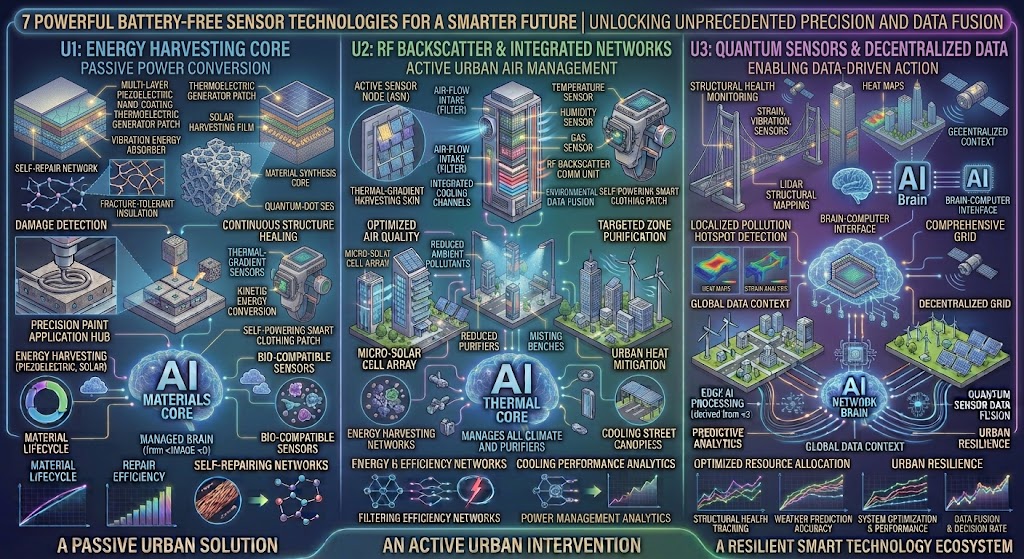
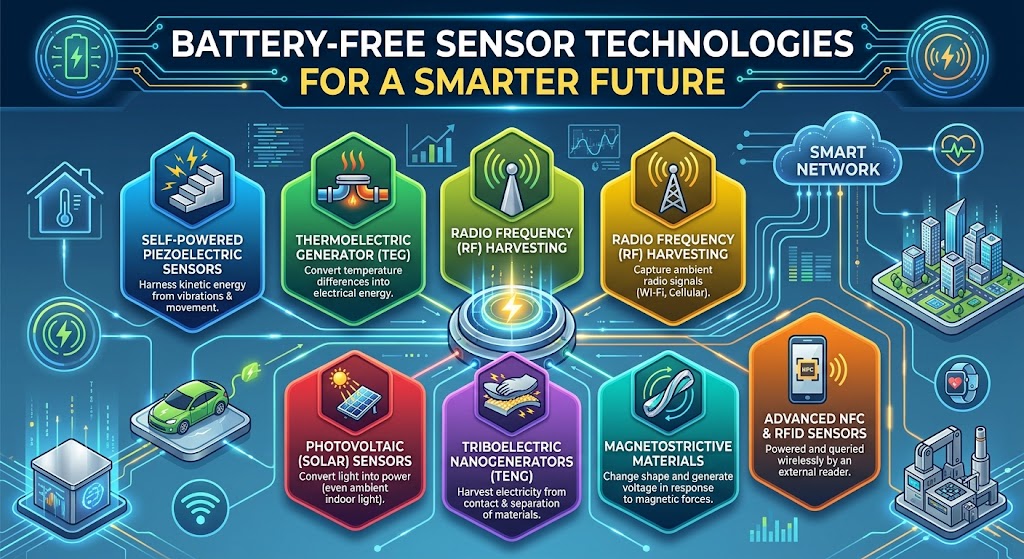
A battery-free sensor may use a tiny photovoltaic cell, a piezoelectric material, a thermoelectric generator, an RF energy harvester, or a triboelectric device. The harvested energy is then managed carefully so the sensor can perform a specific task, such as measuring temperature, pressure, vibration, humidity, movement, or biological signals.
The key idea is efficiency. Rather than keeping a sensor continuously powered, an energy-efficient system can remain dormant and wake up when enough energy is available or when an important event occurs. Research on MEMS inertial switches, for example, highlights event-based sensing as one approach for reducing energy demands in resource-limited sensor systems.
Why Battery-Free Sensor Technologies Matter
Traditional wireless sensors can require regular battery replacement, especially when thousands of devices are distributed across large areas. Sensors installed inside walls, bridges, machines, agricultural fields, pipelines, or remote environmental locations may be difficult to access.
Battery-Free Sensor Technologies address part of this problem by reducing dependence on conventional batteries. This does not mean every battery-free sensor can operate forever under every condition. Instead, the technology attempts to match the sensor’s energy requirements with the energy naturally available in its environment.
This concept is particularly important for IoT networks. NIST research has highlighted the importance of energy harvesting for IoT infrastructure because very large numbers of connected devices create significant energy and maintenance challenges.
Light-Powered Battery-Free Sensor Technologies
One of the most practical forms of Battery-Free Sensor Technologies uses light as an energy source. Small photovoltaic cells can convert sunlight or indoor artificial light into electrical energy that powers ultra-low-power electronics.
Outdoor sensors can potentially use relatively strong sunlight, while indoor devices may use specialized indoor photovoltaic materials designed for weaker illumination. A 2025 review in Nature Reviews Clean Technology examined indoor photovoltaics as a way to power IoT sensors and noted that appropriate power-management hardware is important for extracting and using the available energy efficiently.
This technology could be useful for smart buildings, warehouse monitoring, environmental sensors, and connected objects. A major advantage is that light can be available for long periods without requiring physical movement.
Indoor Battery-Free Sensor Technologies
Indoor environments create a different challenge because artificial lighting is much weaker than direct sunlight. Researchers are therefore exploring photovoltaic materials and device designs optimized for indoor conditions.
The sensor does not necessarily need continuous high power. It can accumulate energy and then perform measurements or transmit information when enough energy has been collected. This makes light-powered designs particularly interesting for low-power IoT applications.
Vibration-Based Battery-Free Sensor Technologies
Another promising category of Battery-Free Sensor Technologies uses movement and vibration. Piezoelectric materials can generate electrical energy when mechanically deformed, making them useful for systems exposed to vibration, pressure, or repeated movement.
Research published in npj Flexible Electronics in 2025 reviewed flexible piezoelectric materials that can combine sensing, actuation, and energy harvesting.
This approach could be useful around industrial machinery, transportation systems, wearable devices, and mechanical structures. A sensor attached to a vibrating machine could potentially use some of that vibration as its own energy source.
The limitation is that vibration is not always available. When the surrounding object stops moving, the available harvested energy can drop significantly. This is why power storage and intermittent sensing strategies remain important.
Heat-Powered Battery-Free Sensor Technologies
Heat is another possible energy source for Battery-Free Sensor Technologies. Thermoelectric generators can convert temperature differences into electrical energy.
A sensor placed between a warmer and cooler surface may be able to harvest a small amount of power while monitoring temperature or another physical condition. This could have applications in industrial equipment, buildings, wearable technology, and infrastructure monitoring.
Recent research on battery-free biosensors has examined thermoelectric harvesting from body heat as one approach for supporting wearable monitoring.
The major challenge is maintaining a useful temperature difference. If both sides of a thermoelectric device reach nearly the same temperature, energy generation becomes much less effective.
RF-Powered Battery-Free Sensor Technologies
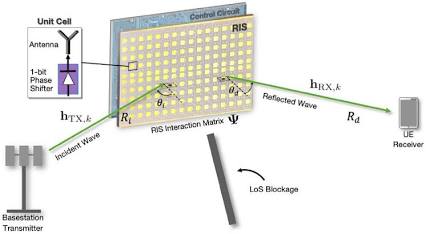
Radio-frequency energy is another interesting source for Battery-Free Sensor Technologies. Instead of generating energy directly from sunlight or movement, a device can harvest electromagnetic energy from nearby radio-frequency sources or dedicated wireless power systems.
RF-powered sensors can be particularly attractive when physical access is difficult. Some systems can use wireless signals to provide both energy and a communication pathway.
Research into battery-free implantable sensors has also explored wireless power transfer and energy-harvesting approaches for long-term bioelectronic systems.
One advantage is that the sensor can potentially be placed in locations where light and mechanical movement are limited. However, distance, orientation, frequency, efficiency, and regulatory constraints can affect performance.
Triboelectric Battery-Free Sensor Technologies
Triboelectric technology is another fascinating area of Battery-Free Sensor Technologies. Triboelectric devices generate electrical effects through contact and separation or friction between materials.
This makes them useful for detecting movement, touch, pressure, vibration, and other mechanical events while simultaneously generating small amounts of electrical energy.
A 2025 review in Nature Reviews Electrical Engineering discussed triboelectric nanogenerators and their potential relationship with self-powered sensing, energy harvesting, and IoT systems.
The technology is particularly interesting because the same mechanical interaction can sometimes provide both the physical signal and the energy needed for sensing. This creates opportunities for smart surfaces, wearable electronics, tactile sensors, and interactive devices.
Battery-Free Sensor Technologies for Healthcare
Healthcare is becoming an important application area for Battery-Free Sensor Technologies. Wearable and implantable sensors need to be small, comfortable, reliable, and capable of operating for long periods.
Conventional batteries can increase size and create maintenance or replacement challenges. Battery-free designs can instead explore RF power, body heat, movement, light, or other energy sources.
Recent research published in Nature Sensors in 2026 reviewed wireless and battery-free implantable sensing technologies, including wireless telemetry, energy harvesting, and power-transfer approaches.
Wearable systems can also use flexible materials that conform to the body. In some cases, the energy source and sensor can be integrated into a thin structure, reducing the need for bulky electronics.
Battery-Free Sensor Technologies and Smart Wearables
A wearable sensor could potentially collect movement, pressure, temperature, or other signals while using harvested energy. However, continuous high-data-rate wireless transmission remains difficult because communication can consume more energy than simple sensing.
For that reason, future Battery-Free Sensor Technologies are likely to emphasize event-based operation, local processing, and highly efficient communication.
Battery-Free Sensor Technologies for Smart Environments
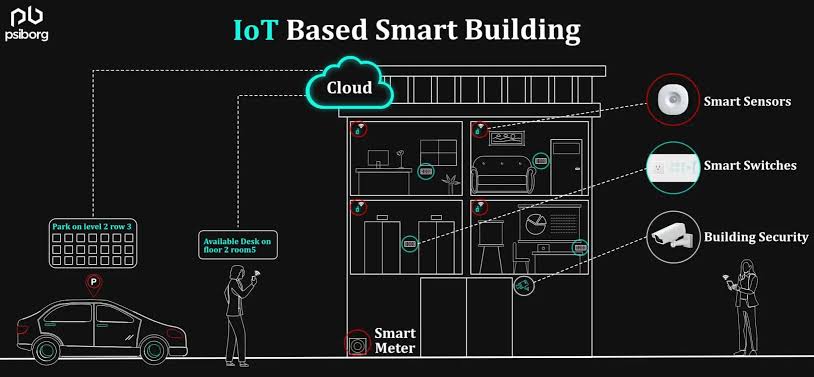
Smart buildings could also benefit from Battery-Free Sensor Technologies. Imagine small sensors monitoring temperature, humidity, occupancy, vibration, or equipment conditions without requiring frequent battery replacement.
A large building may contain hundreds or thousands of sensing points. Reducing maintenance requirements could make distributed monitoring more practical.
Environmental monitoring is another promising area. Research on distributed environmental sensor networks is exploring materials and architectures that can support large-scale sensing systems.
These systems could eventually support more detailed monitoring of agriculture, infrastructure, air quality, water systems, and ecosystems.
Battery-Free Sensor Technologies Comparison
| Technology | Main Energy Source | Potential Applications | Main Challenge |
|---|---|---|---|
| Photovoltaic | Light | Buildings, IoT, outdoor monitoring | Low light indoors |
| Piezoelectric | Vibration or pressure | Machines, wearables | Requires mechanical activity |
| Thermoelectric | Temperature difference | Wearables, industrial systems | Needs temperature gradient |
| RF Harvesting | Radio waves | Wireless sensors, implants | Power decreases with distance |
| Triboelectric | Contact and motion | Touch, movement, wearables | Variable mechanical input |
The table shows why there is no single solution for every environment. The best design depends on where the sensor will operate and what type of ambient energy is available.
How Battery-Free Sensor Technologies Could Grow
The future of Battery-Free Sensor Technologies will likely depend on combining several technologies rather than relying on one energy source. A sensor could potentially combine indoor photovoltaics with RF harvesting, or thermoelectric harvesting with extremely low-power electronics.
Another important development is edge processing. Instead of transmitting every raw measurement to a server, a sensor can process information locally and send only important events. This reduces communication energy requirements.
Research into low-power IoT systems increasingly focuses on reducing the energy used by sensing, processing, memory, and communication together rather than optimizing only the sensor itself.
Illustrative Technology Potential
The following chart is illustrative, not a measured market forecast. It shows how different energy sources may fit different environments based on their typical operating conditions.
The purpose of this graph is to demonstrate the concept rather than claim that one technology universally performs better than another. Real-world performance depends heavily on illumination, vibration frequency, temperature difference, RF distance, device architecture, and power requirements.
Challenges Facing Battery-Free Sensor Technologies
Despite their potential, Battery-Free Sensor Technologies still face important engineering challenges. Energy availability is often unpredictable, and harvested power can be extremely small.
A sensor that works perfectly in sunlight may stop functioning in darkness. A vibration-powered sensor may have little energy when a machine is idle. A thermoelectric system may struggle when there is not enough temperature difference.
Communication is another challenge. Measuring a signal may require very little energy, but transmitting data wirelessly can require considerably more. This is why efficient communication protocols, local processing, event-driven sensing, and temporary energy storage are important parts of battery-free system design.
Researchers are also working on flexible and miniaturized devices. Magnetoelectric MEMS/NEMS systems, for example, are being explored for sensing, communication, and wireless power transfer in compact IoT architectures.
The Future of Battery-Free Sensor Technologies
The long-term direction of Battery-Free Sensor Technologies is closely connected to the growth of low-power IoT. As sensors become smaller and more numerous, traditional battery maintenance becomes increasingly inconvenient for certain applications.
Future systems may combine multiple energy sources, ultra-low-power processors, advanced materials, wireless power transfer, and intelligent algorithms. Instead of asking how long a battery can last, engineers can design systems around how efficiently a device can sense, process, communicate, and sleep.
This creates a particularly interesting low-competition technology niche for readers interested in future IoT, smart materials, wearable electronics, and sustainable computing.
Conclusion
Battery-Free Sensor Technologies represent a major shift in how future connected devices could be powered. Light-powered sensors, vibration-based systems, thermoelectric generators, RF harvesting, and triboelectric devices each offer different ways to reduce dependence on traditional batteries.
The technology is not a universal replacement for batteries, and many applications still require energy storage or external power. However, advances in ultra-low-power electronics, energy harvesting, wireless communication, and smart sensing are making battery-free operation increasingly practical for selected applications. Recent research across IoT, healthcare, flexible electronics, and implantable systems shows that this field is continuing to develop rapidly.
As connected devices become smaller, smarter, and more widely distributed, Battery-Free Sensor Technologies could become an important part of the next generation of IoT systems.