Sound-to-3D Image Technologies are creating new ways to turn acoustic information into detailed three-dimensional representations of objects, environments, and biological structures. Instead of depending entirely on visible light, these technologies use sound waves, ultrasound, acoustic reflections, or sound-generated signals to understand what exists around or inside a target. Recent research has demonstrated advanced three-dimensional acoustic tomography, ultrasound-based reconstruction of hidden scenes, and new volumetric ultrasound and photoacoustic imaging methods.
This makes Sound-to-3D Image Technologies an interesting low-competition technology topic because it connects artificial intelligence, acoustic engineering, medical imaging, robotics, sensing, and computer vision. Some of these systems are already being studied for healthcare and scientific research, while others could eventually help machines understand spaces that cameras cannot easily see.
Table of Contents
- What Are Sound-to-3D Image Technologies?
- How Sound-to-3D Image Technologies Work
- 3D Acoustic Tomography Technologies
- Ultrasound Volumetric Imaging Technologies
- Photoacoustic 3D Imaging Technologies
- Sound-to-3D Image Technologies for Hidden Objects
- Acoustic Imaging for Robotics
- Sound-to-3D Image Technologies for Healthcare
- AI-Powered Sound-to-3D Image Technologies
- Challenges and Future Possibilities
- Conclusion
What Are Sound-to-3D Image Technologies?
Sound-to-3D Image Technologies are systems that collect acoustic information and transform it into a three-dimensional representation. The basic idea is similar to how sonar can determine information about an underwater object, but modern systems can use much more advanced sensors, signal processing, beamforming, tomography, and artificial intelligence.
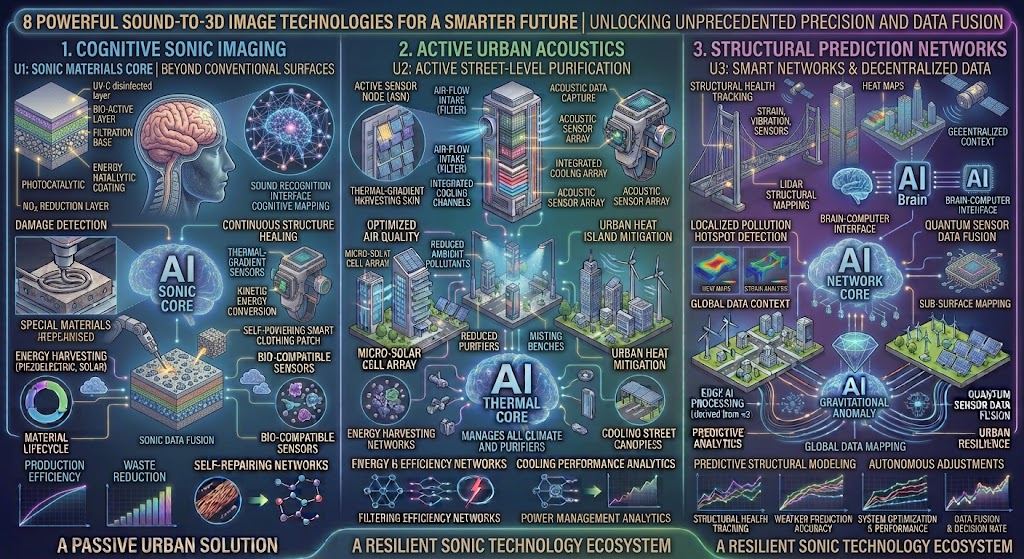
When sound waves travel through or around an object, they interact with different materials. Some energy can be reflected, absorbed, scattered, or transmitted. Sensors can capture these changes, and computer algorithms can use the resulting data to reconstruct information about the object’s shape, position, internal structure, or surrounding environment.
Modern 3D ultrasound research shows that volumetric imaging can provide three-dimensional visualization while remaining non-ionizing and potentially portable compared with some other imaging modalities.
How Sound-to-3D Image Technologies Work
The process behind Sound-to-3D Image Technologies normally begins with an acoustic signal. A transmitter may send sound or ultrasound waves toward a target, while one or more receivers measure returning signals.
The system then analyzes characteristics such as travel time, amplitude, phase, frequency, and direction. Advanced reconstruction algorithms combine these measurements to estimate the three-dimensional structure of the target.
This is where computing becomes extremely important. A sensor may collect thousands or millions of measurements, but those measurements do not automatically form a 3D image. Algorithms must interpret the acoustic data and reconstruct a useful representation.
Machine learning can further assist this process by learning relationships between acoustic measurements and known objects, structures, or environments.
3D Acoustic Tomography Technologies
One of the most advanced examples of Sound-to-3D Image Technologies is three-dimensional acoustic tomography. In 2025, researchers reported a technique called three-dimensional diffractive acoustic tomography, or 3D-DAT, that combines ultrasound and photoacoustic imaging using a modified linear-array transducer.
The research demonstrated three-dimensional structural, functional, and molecular imaging in experimental biological models. The system used acoustic diffraction and computational reconstruction to produce volumetric information.
A particularly interesting feature is that the approach can use widely available linear-array transducers instead of relying entirely on specialized matrix-array hardware. The researchers reported improved elevational resolution and much faster reconstruction using GPU-based processing.
Why 3D Acoustic Tomography Matters
Traditional imaging can sometimes provide only a limited view of a complex structure. Tomographic approaches attempt to reconstruct information from multiple measurements, producing a more complete representation.
This could make Sound-to-3D Image Technologies valuable for biomedical research, materials analysis, and other applications where understanding depth is important.
Ultrasound Volumetric Imaging Technologies
Ultrasound is one of the clearest examples of Sound-to-3D Image Technologies already being used in real-world imaging. Traditional ultrasound often produces two-dimensional cross-sectional images, while 3D ultrasound collects enough spatial information to construct a volume.
Modern approaches can use matrix arrays, mechanically steered probes, freehand scanning, or computational reconstruction. A 2025 review of three-dimensional ultrasound described these approaches and discussed applications across areas including obstetrics, cardiovascular medicine, oncology, musculoskeletal imaging, and surgery.
The advantage of volumetric information is that clinicians and researchers can examine structures from different viewpoints instead of relying on a single slice.
However, 3D ultrasound also presents challenges involving hardware complexity, data processing, rendering, and analysis.
Photoacoustic 3D Imaging Technologies
Another important category of Sound-to-3D Image Technologies is photoacoustic imaging. Unlike conventional ultrasound, photoacoustic imaging begins with light. Short optical pulses are absorbed by tissues, producing tiny temperature changes and resulting acoustic waves.
Those acoustic waves can then be detected and reconstructed into images. This allows the system to combine optical contrast with ultrasonic detection.
Recent research has demonstrated advanced three-dimensional photoacoustic systems capable of visualizing anatomical, functional, and molecular information. A 2025 Nature Communications study described 3D-DAT as a system capable of simultaneous 3D ultrasound and photoacoustic imaging.
Another 2025 study introduced 3D panoramic photoacoustic computed tomography for broad three-dimensional visualization of physiological dynamics.
Sound-to-3D Image Technologies in Biomedical Research
These developments are particularly interesting because sound is being used as the detected signal even when the original energy source is optical.
This creates hybrid imaging systems that can reveal information that conventional cameras or ordinary ultrasound may not provide alone.
Sound-to-3D Image Technologies for Hidden Objects
One of the most unusual applications of Sound-to-3D Image Technologies is imaging objects that are not directly visible.
In 2025, researchers reported an ultrasound-based non-line-of-sight imaging system capable of reconstructing hidden scenes using sound. The system used a scanning ultrasound emitter and receiver and demonstrated 3D reconstruction of multiple targets behind a scattering surface.
The reported experiments achieved approximately centimeter-scale depth and spatial resolution at distances up to around two meters from the scattering surface.
This concept could eventually become useful in environments where direct camera visibility is limited.
For example, acoustic sensing could potentially help machines understand areas around corners, behind obstacles, or within visually difficult environments.
Acoustic Imaging for Robotics
Robots increasingly need to understand their surroundings. Cameras provide valuable visual information, but they can struggle with darkness, smoke, dust, fog, reflective surfaces, or physical obstacles.
Sound-to-3D Image Technologies could provide another sensing layer for robots.
A robot equipped with acoustic transmitters and receivers could analyze reflections to estimate the position and shape of objects. Combined with cameras, LiDAR, radar, and AI, acoustic imaging could become another part of multimodal robotic perception.
This does not mean sound will replace cameras or LiDAR. Instead, the technology could complement existing sensors in situations where acoustic information provides something different.
Sound-to-3D Image Technologies for Healthcare
Healthcare is one of the most important areas for Sound-to-3D Image Technologies. Ultrasound already provides a non-ionizing imaging method, and three-dimensional ultrasound can provide more spatial context than conventional 2D scans.
Researchers are also exploring hybrid systems that combine ultrasound with photoacoustic imaging. These systems can potentially provide both structural and functional information.
A 2025 Nature Biomedical Engineering study reported rotational ultrasound and photoacoustic tomography capable of producing three-dimensional panoramic images of the human head, breast, hand, and foot in experimental imaging. The reported system achieved submillimeter isotropic resolution with approximately 10-second imaging time for each modality.
These developments show how acoustic imaging can move beyond simple 2D pictures toward richer volumetric visualization.
Sound-to-3D Image Technologies for Deep Tissue
Sound can travel through biological tissue differently from visible light, which is one reason ultrasound is useful for deeper imaging.
Photoacoustic and ultrasound systems can therefore provide complementary information. Researchers are also investigating approaches for imaging through challenging structures such as the skull.
AI-Powered Sound-to-3D Image Technologies
Artificial intelligence could become one of the most important parts of Sound-to-3D Image Technologies.
Raw acoustic data can be extremely complicated. AI models can help identify patterns, reduce noise, reconstruct missing information, classify structures, and accelerate image formation.
Machine learning may also help reduce the computational burden of reconstruction. Instead of processing every stage entirely through traditional mathematical methods, researchers can train models to estimate parts of the reconstruction process.
This could make future acoustic imaging systems faster and potentially easier to operate.
Sound-to-3D Image Technologies Comparison
| Technology | Main Signal | 3D Output | Potential Application |
|---|---|---|---|
| Acoustic Tomography | Sound/Ultrasound | Volumetric structure | Biomedical research |
| 3D Ultrasound | Ultrasound echoes | Anatomical volume | Healthcare |
| Photoacoustic Imaging | Light-generated sound | Functional 3D image | Biomedical imaging |
| NLOS Acoustic Imaging | Reflected ultrasound | Hidden scene | Robotics and sensing |
| AI Acoustic Reconstruction | Acoustic data | Computed 3D model | Smart sensing |
| Acoustic Material Imaging | Sound interactions | Material structure | Industrial inspection |
| Volumetric Ultrasound | Ultrasound | 3D anatomy | Medical imaging |
| Hybrid Acoustic Imaging | Multiple signals | Multimodal 3D data | Advanced research |
The table shows that Sound-to-3D Image Technologies are not one single invention. They represent a wider group of technologies that use acoustic information to create or improve three-dimensional representations.
Illustrative Technology Development Graph
The following graph is illustrative rather than a market forecast. It represents the conceptual maturity of different applications based on how established the underlying imaging approaches are, not measured market-share data.
The purpose of this graph is to show that some acoustic 3D applications are already relatively established, while other emerging areas remain primarily research-focused.
Challenges of Sound-to-3D Image Technologies
Despite impressive progress, Sound-to-3D Image Technologies still face several technical challenges.
Sound behaves differently depending on the environment and material. Reflections can create complicated patterns, while noise can make reconstruction more difficult. Some materials may absorb or scatter acoustic energy strongly, reducing the quality of the detected signal.
Another challenge is computational demand. High-quality 3D reconstruction can require large amounts of data and significant processing power. Researchers are therefore working on faster reconstruction algorithms and improved hardware.
For medical applications, additional challenges include safety, image quality, workflow integration, regulatory requirements, and demonstrating clinical value. A recent review of photoacoustic imaging emphasizes that translating advanced imaging systems into useful clinical applications requires clearly defined advantages and suitable clinical niches.
The Future of Sound-to-3D Image Technologies
The future of Sound-to-3D Image Technologies could involve much more than traditional ultrasound. Acoustic sensing may increasingly combine with artificial intelligence, robotics, optical imaging, and other sensor technologies.
Future systems could become smaller and faster while producing richer 3D information. Portable ultrasound devices, wearable sensors, robotic acoustic vision, and hybrid imaging platforms are all areas where research could continue to expand.
Another exciting possibility is multimodal perception. A future robot might combine camera images, LiDAR measurements, radar signals, and acoustic information into a single 3D model. Each sensor would contribute information that the others may miss.
This could create more resilient machine perception for healthcare, manufacturing, autonomous systems, and difficult environments.
Conclusion
Sound-to-3D Image Technologies are opening an unusual and promising direction in modern sensing and imaging. From 3D ultrasound and acoustic tomography to photoacoustic imaging and hidden-scene reconstruction, researchers are finding increasingly sophisticated ways to transform sound-related signals into three-dimensional information.
Recent studies demonstrate that acoustic technologies can support volumetric biomedical imaging, hidden-scene reconstruction, and hybrid imaging systems.
The technology is still developing, and many futuristic applications remain experimental. However, the combination of acoustic sensing, powerful computing, and AI could make Sound-to-3D Image Technologies an important part of future imaging and machine perception.
For technology readers looking for a relatively low-competition topic, this field offers a fascinating intersection of sound, artificial intelligence, medical imaging, robotics, and 3D visualization.