Invisible Touch Interface Technologies are changing the way people can interact with digital devices without relying entirely on physical buttons, keyboards, or conventional touchscreens. Instead of pressing a visible surface, users can interact through gestures, mid-air haptics, electromagnetic sensing, wearable interfaces, and other technologies that detect or simulate touch without requiring a traditional physical control. Research into ultrasonic holography, mid-air haptics, wearable haptic systems, and touchless interaction continues to expand the possibilities of these interfaces.
The idea sounds futuristic, but several parts of this technology are already being researched and demonstrated. Invisible Touch Interface Technologies could eventually make car dashboards, public kiosks, smart appliances, virtual-reality systems, medical equipment, and industrial controls more interactive while reducing the need for physical surfaces 9 Powerful Invisible Touch Technologies for a Smarter Future.
Table of Contents
- What Are Invisible Touch Interface Technologies?
- How Invisible Touch Interface Technologies Work
- Ultrasonic Mid-Air Touch
- Infrared Gesture Interfaces
- Electromagnetic Touchless Sensing
- Mid-Air Haptic Feedback
- Invisible 3D Haptic Interfaces
- Wearable Touch Interfaces
- AI-Powered Invisible Touch Interfaces
- Touchless Interfaces for Cars and Smart Homes
- Challenges of Invisible Touch Interface Technologies
- Future of Invisible Touch Interface Technologies
- Conclusion
What Are Invisible Touch Interface Technologies?
Invisible Touch Interface Technologies are systems that allow users to interact with digital controls without necessarily touching a conventional physical surface. Some technologies detect the user’s hand position or gesture, while others provide tactile feedback in mid-air so the user can feel where an invisible control exists 9 Powerful Invisible Touch Technologies for a Smarter Future.
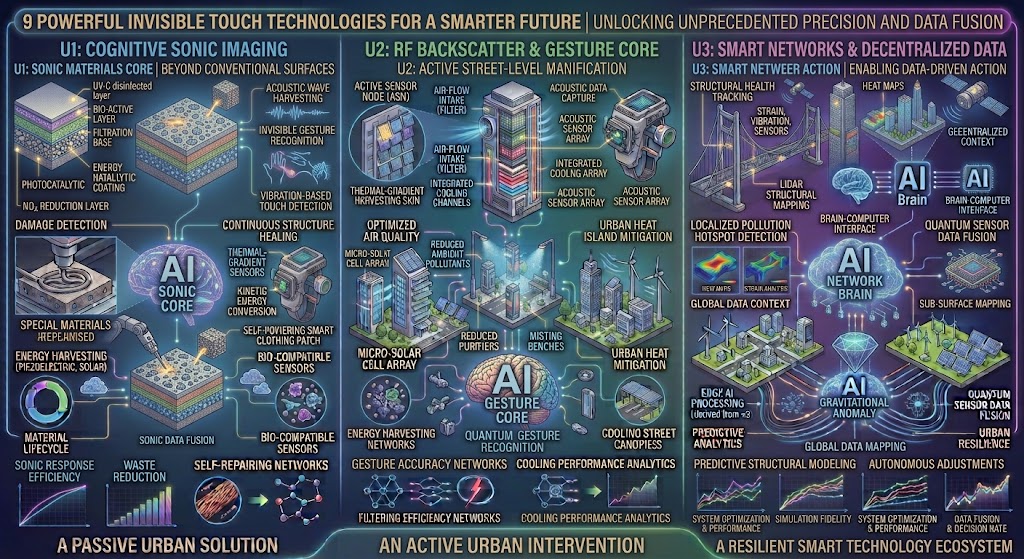
This distinction is important. A touchless interface may simply recognize a gesture, but an invisible touch interface can go further by giving the user some form of physical feedback 9 Powerful Invisible Touch Technologies for a Smarter Future.
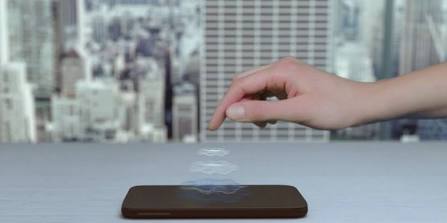
For example, an ultrasonic system can create focused acoustic fields above a device. The user cannot see the acoustic field, but carefully controlled ultrasound can create a tactile sensation on the skin. Earlier demonstrations showed how ultrasonic transducer arrays could create touchable regions in mid-air 9 Powerful Invisible Touch Technologies for a Smarter Future.
How Invisible Touch Interface Technologies Work
The basic process behind Invisible Touch Interface Technologies usually combines sensing with feedback. A camera, infrared sensor, electromagnetic system, radar-like sensor, or another detector first identifies where the user’s hand or fingers are located 9 Powerful Invisible Touch Technologies for a Smarter Future.
Software then interprets the movement as an interaction. If the system includes haptic feedback, another component generates a physical sensation that tells the user where or when an interaction has occurred.
Ultrasonic systems are a good example. Arrays of transducers can create carefully controlled acoustic fields. By changing the timing and phase of signals across the array, researchers can concentrate acoustic energy at selected locations. Modern research continues to improve the measurement and generation of these acoustic holograms for applications including mid-air haptics 9 Powerful Invisible Touch Technologies for a Smarter Future.
Ultrasonic Mid-Air Touch
One of the most recognizable forms of Invisible Touch Interface Technologies is ultrasonic mid-air haptics. Instead of putting buttons on a physical panel, ultrasonic transducers can create tactile sensations above a surface.
The technology works by controlling many ultrasonic emitters together. Focused sound waves can generate localized pressure effects that a person can perceive with their skin 9 Powerful Invisible Touch Technologies for a Smarter Future.
This can make a virtual button feel more like a physical control. The user might move a finger through the air and feel a small tactile response when reaching a virtual control 9 Powerful Invisible Touch Technologies for a Smarter Future.
Research published in Communications Engineering in 2025 examined faster measurement of in-air ultrasound holography and its relationship to mid-air haptics and volumetric displays.
Invisible Touch Interface Technologies and Ultrasonic Feedback
The major advantage is that the interface does not need a physical surface at the exact location where the sensation is produced 9 Powerful Invisible Touch Technologies for a Smarter Future.
This could be useful for applications where cleanliness, accessibility, or flexible interaction is important. However, the system still needs accurate hand tracking and carefully controlled acoustic fields 9 Powerful Invisible Touch Technologies for a Smarter Future.
Infrared Gesture Interfaces
Another category of Invisible Touch Interface Technologies uses infrared sensing to detect hand and finger movement.
Infrared cameras or depth-sensing systems can observe the position of a hand without requiring the user to touch anything. Software can then interpret movements as commands 9 Powerful Invisible Touch Technologies for a Smarter Future.
For example, moving a hand sideways could change a setting, while a pinching gesture could select an object.
Gesture recognition has already become an important research area in human-computer interaction. Recent research into skin-conformal electronics is also exploring real-time gesture recognition through electronics that naturally conform to the body.
Infrared systems can therefore become one part of a larger invisible interface, especially when combined with visual displays or haptic feedback 9 Powerful Invisible Touch Technologies for a Smarter Future.
Electromagnetic Touchless Sensing
Electromagnetic sensing provides another path toward Invisible Touch Interface Technologies. Instead of relying entirely on cameras, a system can detect changes in electromagnetic fields caused by the presence or movement of a person.
This approach can potentially detect touch, proximity, or gestures while reducing dependence on visible-light imaging.
Body-coupled electronics are also being investigated as a way to detect interactions through the human body. A 2025 study described a minimalist body-coupled human-machine interface designed for multifunctional touch detection 9 Powerful Invisible Touch Technologies for a Smarter Future.
These technologies show how future interfaces may detect interaction using electrical signals rather than conventional mechanical switches.
Mid-Air Haptic Feedback
Detection alone is not enough for many applications. Users need feedback so they know that a command has been recognized 9 Powerful Invisible Touch Technologies for a Smarter Future.
This is where mid-air haptics becomes important in Invisible Touch Interface Technologies.
Focused ultrasound can create tactile sensations without requiring direct contact with a physical actuator. Earlier demonstrations showed ultrasonic interfaces that allowed users to interact with invisible controls and receive tactile feedback in mid-air.
More recent research is investigating the physics of acoustic streaming in phased arrays because the movement of air generated by ultrasound can influence haptic sensations and other applications. A 2026 npj Acoustics study examined acoustic streaming in mid-air phased arrays and its relevance to haptics and levitation 9 Powerful Invisible Touch Technologies for a Smarter Future.
Invisible 3D Haptic Interfaces
A particularly futuristic branch of Invisible Touch Interface Technologies is three-dimensional haptic interaction.
Instead of having a flat invisible button, the system can potentially create tactile points at different positions in space. This could allow users to explore virtual objects or 3D information using their hands.
Earlier ultrasonic research demonstrated the concept of feeling invisible 3D shapes through focused ultrasound. Such systems have been explored for applications including virtual reality and medical visualization 9 Powerful Invisible Touch Technologies for a Smarter Future.
The long-term idea is powerful: a person could see a virtual object and physically feel parts of it without touching a physical object.
Invisible Touch Interface Technologies in Virtual Reality
Virtual reality is a natural application because users already interact with digital environments that have no physical equivalent.
Haptic feedback can provide additional information about virtual objects, buttons, surfaces, or boundaries. Wearable multi-sensory haptic systems are also being researched to improve human interaction with digital environments 9 Powerful Invisible Touch Technologies for a Smarter Future.
Wearable Invisible Touch Interface Technologies
Not every invisible interface has to operate in mid-air. Wearable systems can create another type of Invisible Touch Interface Technologies by turning the user’s skin or clothing into part of the interaction system.
Flexible haptic interfaces can provide tactile feedback directly through the skin. A 2025 Nature Electronics study described a flexible skin-mounted haptic interface designed to provide multimodal cutaneous feedback 9 Powerful Invisible Touch Technologies for a Smarter Future.
This could eventually allow a smartwatch, AR headset, or wearable computer to communicate information through subtle sensations instead of relying only on a screen.
For example, a wearable could provide directional feedback through different areas of the skin, allowing the user to receive information without constantly looking at a display.
AI-Powered Invisible Touch Interface Technologies
Artificial intelligence can make Invisible Touch Interface Technologies much more capable.
An AI system can analyze hand movement, finger position, timing, context, and previous interactions to determine what the user intends to do 9 Powerful Invisible Touch Technologies for a Smarter Future.
This is particularly important because human gestures are not always perfectly consistent. A rigid system may misunderstand a movement, while an adaptive model can potentially learn different patterns.
Research into non-invasive neuromotor interfaces is also exploring ways of translating neural and motor signals into computer commands without traditional physical input devices. A 2025 Nature study presented a non-invasive neuromotor interface for human-computer interaction and highlighted the limitations of conventional gesture systems when movements are obscured.
This suggests that future invisible interfaces may combine multiple forms of sensing instead of depending on a single camera or sensor 9 Powerful Invisible Touch Technologies for a Smarter Future.
Invisible Touch Interface Technologies for Cars
Cars are an especially interesting application for Invisible Touch Interface Technologies because drivers need to interact with controls while maintaining attention on the road.
A physical button can be located by touch, but a flat touchscreen may require visual attention. Mid-air haptics could potentially create tactile feedback around virtual controls without requiring a physical switch.
Earlier ultrasonic interface demonstrations explored applications in vehicles and showed how invisible tactile controls could be combined with gesture recognition 9 Powerful Invisible Touch Technologies for a Smarter Future.
Future systems could potentially combine voice, gesture, eye tracking, and haptic feedback into one interface.
Invisible Touch Interface Technologies for Smart Homes
Smart homes could also benefit from Invisible Touch Interface Technologies.
Imagine controlling lighting, temperature, music, or appliances through a surface that does not require physical buttons. A user could make a gesture near a wall or countertop and receive tactile feedback confirming the command 9 Powerful Invisible Touch Technologies for a Smarter Future.
The advantage is not simply futuristic appearance. Touchless interaction can be useful when physical contact is inconvenient, when hands are occupied, or when a surface needs to remain easy to clean.
Research into touchless interfaces for interactive environments has also explored how touchless interaction can be integrated into digital experiences.
Invisible Touch Interface Technologies Comparison
| Technology | Main Method | Feedback | Potential Use |
|---|---|---|---|
| Ultrasonic Haptics | Focused ultrasound | Mid-air pressure sensation | Cars, VR, controls |
| Infrared Gesture | Infrared sensing | Visual or haptic | Smart homes |
| Electromagnetic Sensing | Electrical fields | Digital response | Wearables |
| Acoustic Holography | Shaped ultrasound fields | Spatial haptics | 3D interfaces |
| Wearable Haptics | Skin-mounted actuators | Skin sensation | AR/VR |
| AI Gesture Recognition | Machine learning | Digital/haptic | Human-computer interaction |
| Neural Interfaces | Motor/neural signals | Digital response | Advanced computing |
| Touchless Public Interfaces | Gesture/proximity sensing | Visual/audio/haptic | Kiosks |
| Multimodal Interfaces | Multiple sensors | Combined feedback | Future devices |
Illustrative Technology Development Graph
The following graph is illustrative, not a market-size or performance forecast. It represents a conceptual view of how closely different technologies are connected to current touchless interaction research.
The graph is intended only to visualize the different areas discussed in this article. It should not be interpreted as a ranking of commercial products or research programs.
Challenges of Invisible Touch Interface Technologies
Despite their potential, Invisible Touch Interface Technologies still face several challenges.
The first challenge is accuracy. A system must determine exactly what the user intends to do. Small errors in hand tracking can cause unintended commands, particularly when several virtual controls are close together.
The second challenge is feedback quality. Users need to understand what they are touching or selecting. If the tactile sensation is too weak, inconsistent, or difficult to locate, the interface may become frustrating.
Ultrasonic systems also require careful acoustic-field design. Research published in 2025 showed that measuring and generating precise ultrasound holograms in real-world hardware remains technically challenging.
Another challenge is cost. Advanced sensors, phased arrays, cameras, processors, and specialized actuators can increase the complexity of a device.
Privacy is also important. Interfaces that use cameras, microphones, body signals, or other sensing technologies may collect information about users and their surroundings. Future systems therefore need appropriate privacy and security controls.
The Future of Invisible Touch Interface Technologies
The future of Invisible Touch Interface Technologies will likely involve multimodal interaction rather than a single technology.
A future device could use cameras to track hand position, AI to understand gestures, ultrasonic systems to provide tactile feedback, and voice recognition for additional commands.
Wearable devices may also become important. Instead of forcing users to touch a screen, future computers could communicate through subtle sensations on the skin, gestures, spatial audio, and visual overlays.
Research into wearable multisensory haptics already points toward interfaces that combine different forms of feedback and carefully consider comfort, body location, and human perception.
Another interesting direction is the combination of mid-air haptics with volumetric or spatial displays. The 2025 research on ultrasound holography specifically connects acoustic holography with mid-air haptics and volumetric display applications.
This could eventually make digital objects feel more physical without requiring a traditional physical interface 9 Powerful Invisible Touch Technologies for a Smarter Future.
Conclusion
Invisible Touch Interface Technologies are creating a new direction for human-computer interaction. Instead of limiting interaction to keyboards, buttons, and flat touchscreens, these systems explore gestures, ultrasound, electromagnetic sensing, wearable haptics, AI, and other methods of interacting without conventional physical controls.
Ultrasonic mid-air haptics is one of the most fascinating examples because it can create tactile sensations in locations where no physical button exists. Research in 2025 and 2026 continues to improve the understanding and control of acoustic fields for haptics and related applications 9 Powerful Invisible Touch Technologies for a Smarter Future.
The technology is still developing, and many advanced applications remain experimental. However, the combination of AI, spatial sensing, haptics, and multimodal interfaces could make Invisible Touch Interface Technologies an important part of future cars, smart homes, virtual reality, robotics, healthcare, and everyday computing.
For a relatively low-competition technology topic, invisible interfaces offer a strong combination of futuristic appeal and genuine ongoing research 9 Powerful Invisible Touch Technologies for a Smarter Future.